
Introduction
Digital businesses are growing at a faster pace, and hence, the requirements are constantly changing. With this, Umbraco has proved itself as it has been constantly growing for over 20 years to serve the changing needs of customers. With the introduction of the latest innovations like Umbraco Cloud, Workflow, Commerce, Engage, and now AI-based features and automation, Umbraco has grown into an inclusive digital experience platform from an open-source CMS.
Umbraco is always ready to adjust to the upcoming new technologies, customers' changing expectations, and market requirements. Simplifying content management, improving developers’ capacity, and helping companies provide better digital experiences were the main goals of each new version.
Did you miss the keynote session at Codegarden 2026? We have got you covered, so don't worry.
Codegarden 2026 highlighted Umbraco's continuous evolution, from the most recent product updates and AI advances to the release of powerful new features and the future plan. Let's explore the key points and their impact on companies trying to create more intelligent online experiences.
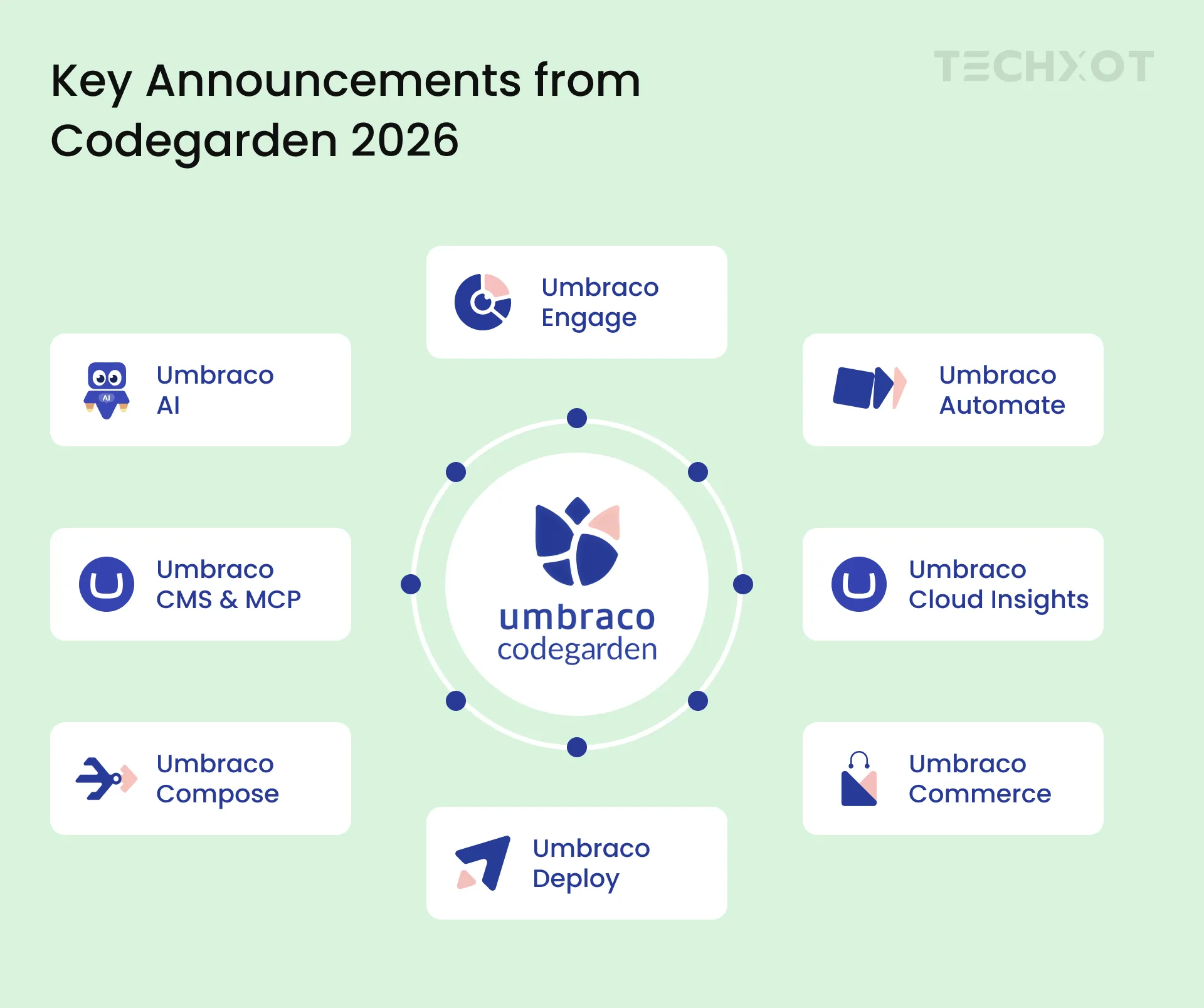
Key Announcements from Codegarden 2026
Umbraco Automate
Umbraco Automate, a new open-source automation engine included right into the Umbraco Backoffice, is one of the most noteworthy announcements from Codegarden 2026. Teams can automate tasks like sales messages, approval processes, onboarding emails, and other routine tasks without using any third-party automation tools.
AI-powered activities are also supported by Umbraco Automate, allowing businesses to merge AI into their processes while maintaining governance and human authorization. Companies benefit from a flexible and scalable automation platform while holding more control over their data because it works within the Umbraco ecosystem.
Umbraco.AI
AI in Umbraco has evolved from an idea towards a practical solution that allows businesses to adopt AI while keeping total control over compliance, security, and governance. According to their needs, businesses may select from a variety of AI models, and integrated filters protect confidential information and guarantee that AI-generated content follows brand guidelines.
A more powerful AI Copilot for editors is also included in the most recent updates. Teams can generate and oversee content more efficiently with features such as:
Speech-to-text content creation
Drag-and-drop file uploads
Semantic search
Support for advanced content structures
Companies can benefit from AI-fuelled productivity without sacrificing quality or control because of manual approval protocols, which ensure editors maintain control.
Umbraco Editor MCP
With the introduction of AI into Umbraco, the platform is allowing teams to access Umbraco content within the AI tools they use. Editors will be able to communicate with Umbraco directly from the selected AI agent because of new MCP (Model Context Protocol) features, which will simplify content generation and management.
No extra systems or complicated integrations are needed; customers can use natural language commands to draft, search, update, and publish content with the new Umbraco Editor MCP. The system, which is hosted directly on Umbraco Cloud, provides a secure environment, has made it easier for businesses to accept AI, and connect them with other tools like Google Drive, Figma, Slack, and Dropbox to create a more connected and AI-equipped digital workplace.
Umbraco CMS
The most recent Umbraco CMS updates concentrate on improving AI capabilities, with a particular focus on using AI in Umbraco to speed up editorial workflows, increase efficiency, and simplify content management. By allowing editors and developers to operate more smoothly, such improvements help companies increase productivity and set a foundation for future developments.
Key Updates:
Improved AI support enables AI agents to understand content structures and make precise content updates.
AI-powered editing features include speech-to-text content creation, semantic search, and support for advanced content structures.
Lightweight external-only members reduce storage and system overhead for websites using third-party authentication providers.
With the introduction of Elements in Umbraco 18, editors can develop and manage reusable content from a single source.
The impending shift from NPoco to Entity Framework Core will bring greater flexibility, a more convenient development environment, and simpler testing.
Developers now have a provider-based design thanks to the new Umbraco Search abstraction layer, which simplifies integration and search engine switching.
Umbraco Cloud Insights
Because of Umbraco Cloud's growing self-service features, teams now have more transparency, authority, and freedom over their digital projects. The new Traffic & Performance Dashboard, which offers the latest data on:
Website traffic: Keep an eye on visitor activity and traffic trends for all your online properties.
Performance metrics: Monitor important metrics like application health and response times to guarantee the best possible user experiences.
Resource usage: To facilitate effective platform management, get insight into CPU, memory, and system resources.
Teams can now keep an eye on and improve their digital platforms without the need for extra tools. Through their CI/CD pipelines, organizations can also deploy straight to any environment, increasing the speed and efficiency of releases.
Umbraco Cloud continues to expand its platform management skills with features such as:
Sustainability tracking: Measure and monitor the environmental impact of your digital setup.
Custom error pages: Create branded error experiences that maintain a reliable user journey.
Environment management: Simplify the administration and configuration of development, staging, and production environments.
Security controls: Boost platform management with better information and application security technologies.
When combined, these improvements support businesses in maintaining high-performing digital experiences, improving governance, and simplifying procedures.
Umbraco Compose: Connecting Content Across Systems
Umbraco Compose has continued to develop since its February 2026 introduction, with changes aimed at increasing visibility, functionality, reliability, and the developer experience in general. Organizations now have more control over data management across different platforms, connectors, and content orchestration, thanks to the most recent improvements.
Major improvements are:
Improved API application management with dedicated controls for scopes, environments, and access permissions.
Ingested Content Diagnosis provides greater visibility into ingested data, content mapping, and GraphQL queryability.
Open-sourced Umbraco CMS connectors and new Outbound Webhook Functions to simplify integrations with external platforms and search engines.
Advanced ingestion controls consist of patch and merge-patch capability for incomplete content updates and filters for data removal.
Strongly written, versatile, and predictable API replies are made possible by improved GraphQL features that enable interfaces and unions.
Larger content activities are supported by increased ingestion limitations at no extra cost across Professional and Enterprise tiers.
Looking ahead, Umbraco plans to introduce dedicated Ingestion Function management, US region support, a CLI tool for automation workflows, and environment synchronization capabilities to further streamline content operations and developer productivity.
Umbraco Commerce: Customer Management
Customer Management is an upcoming feature in Umbraco Commerce that will help enterprises better understand and manage customers. Instead of looking at customer data for multiple orders, teams will be able to see a complete customer profile in one place, with customer details, order history, communication records, addresses, tags, and key metrics such as Customer Lifetime Value (CLV) and Average Order Value (AOV).
The update also launches a dedicated Customer dashboard where teams can search, filter, and find customer information. Features like communication tracking, customer tagging, segmentation, and address management will make it simpler to create stronger customer relationships. In addition, Customer Management can combine with external CRM systems, giving businesses a full view of their customers while improving customer service and sales operations.
Umbraco Engage: Making Analytics Smarter
From Engage 17.2, Umbraco Engage has extended its analytical abilities with the addition of the Traffic Filter. By removing unwanted traffic, such as bots, internal users, or visitors from particular IP addresses, domains, countries, and user agents, this tool helps companies maintain more reliable statistics.
Umbraco plans to use Agent Copilot to offer AI-powered visions to Engage in Q3 2026. With the help of this new feature, customers will be able to engage with analytics data in natural language, which will make it easier to track campaign success, identify high-quality content, examine audience behavior, and find useful data without having to deal with complex reports. Deeper analysis, audience segmentation, and personalized content experiences will be the primary areas of improvement in the future.
Deploy: Simplifying Content and Configuration Management
The upcoming Umbraco 18 version will make deployment management simpler and more efficient. With a better overview that includes environment data, item counts, progress tracking, and more lucid visual indicators, Umbraco Deploy offers a new user experience that improves visibility into deployment activities. Easy export and import choices, direct restore capabilities, and a rearranged settings area for faster access to simplify daily operations. Teams can now handle code and content deployments more quickly and confidently thanks to the new Deploy experience's broader dialogs, simpler navigation, and more user-friendly controls.
Techxot: Your Official Umbraco Implementation Partner
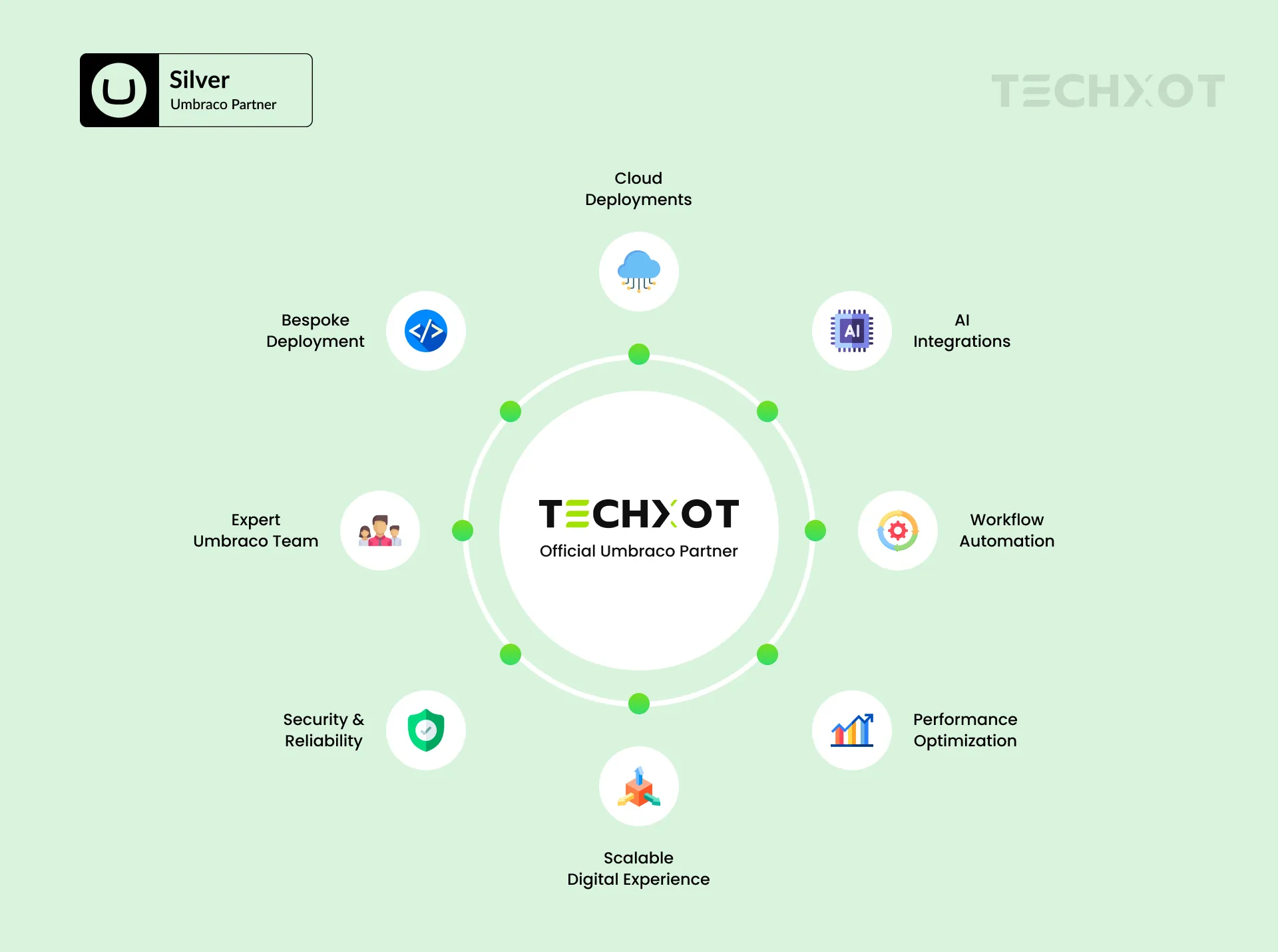
As an official Umbraco Partner, Techxot offers bespoke development, cloud deployments, AI integrations, workflow automation, and performance optimization to help enterprises get the most out of their Umbraco investments. Our team will help you in turning Umbraco's latest developments into measurable business outcomes if you are planning an update, exploring AI-powered content operations, or creating scalable digital experiences.
Are you ready to explore Umbraco's full potential? Get in touch with Techxot to talk about your upcoming digital project.
Conclusion
As this blog post highlighted, Codegarden 2026 shows Umbraco's continuous progress beyond traditional content management. Everything from connecting content across systems, making analytics smarter, to customer management, the platform is consolidating the foundation for future-equipped digital experiences.
These product upgrades demonstrate Umbraco's ongoing dedication to helping companies strengthen productivity, simplifying operations, and giving users personalized digital experiences across platforms. With these capabilities, companies have a great chance to use cloud, automation, and AI technologies to boost growth and keep an edge over their competitors in a world that is becoming more and more digital.