
Introduction
Are you still struggling with downtime in your business because of End-of-life Umbraco versions? Or is your team stuck in high risk and unclear migration paths?
If you are an enterprise struggling with
Legacy Umbraco version blocking your growth
Broken third-party dependencies
Cloud implementation complexity
Deployment inconsistencies
Solving these challenges requires not just any tools but a bundle of strategy, architecture, and execution, which could be well done by not a legacy DXP service provider but someone who understands enterprise scale and complexity to achieve future ready digital ecosystem your business thrives in. We at Techxot do the same, we help enterprises that are investing heavily in technology and tools but have low business ROI, or enterprises with rigid architectures that innovate slow and delay in time to market. Our team helps your enterprise unlock Umbraco cloud features seamlessly and get your business faster to market.
Techxot as has successfully completed 10+ years as a DXP service provider and has completed multiple Umbraco upgrades and migrations over these years. We have successfully worked across various Umbraco versions (v7 to v13+) with an average delivery time of 3-4 months. Techxot has served important industries like- healthcare, e-commerce, finance and manufacturing to build scalable, reliable and performance-oriented and future ready enterprise grade solutions.
1. Recap of the Migration Journey
The official Umbraco v8 stopped its support on 24th February 2025 and officially reached the end of life and created security concerns for enterprises using it. Platform’s heavy reliability on legacy .NET framework handed limited cloud and modernization support. This version mostly worked along with deprecated APIs, custom implementations, and third-party dependencies for its seamless operations. Upgrading to Umbraco v13 requires a full rebuild with clean schema, modern property editors, and stable data structures. Umbraco v8 reached end of life and required to migrate to Umbraco cloud to harness the Umbraco cloud features and be a future ready enterprise. After migrating and deploying the site successfully, one thing became clear: Umbraco Cloud features simplify everything. From managed hosting to version control, the platform removes the operational headaches that typically come with CMS projects.
Challenges Faced during Umbraco v8 to v13 Migration:
– Moving from legacy .NET Framework to modern .NET Core
– Third-party packages were unsupportive
– Content and data migration carried the risk of data loss
– Data structures and content models mismatched
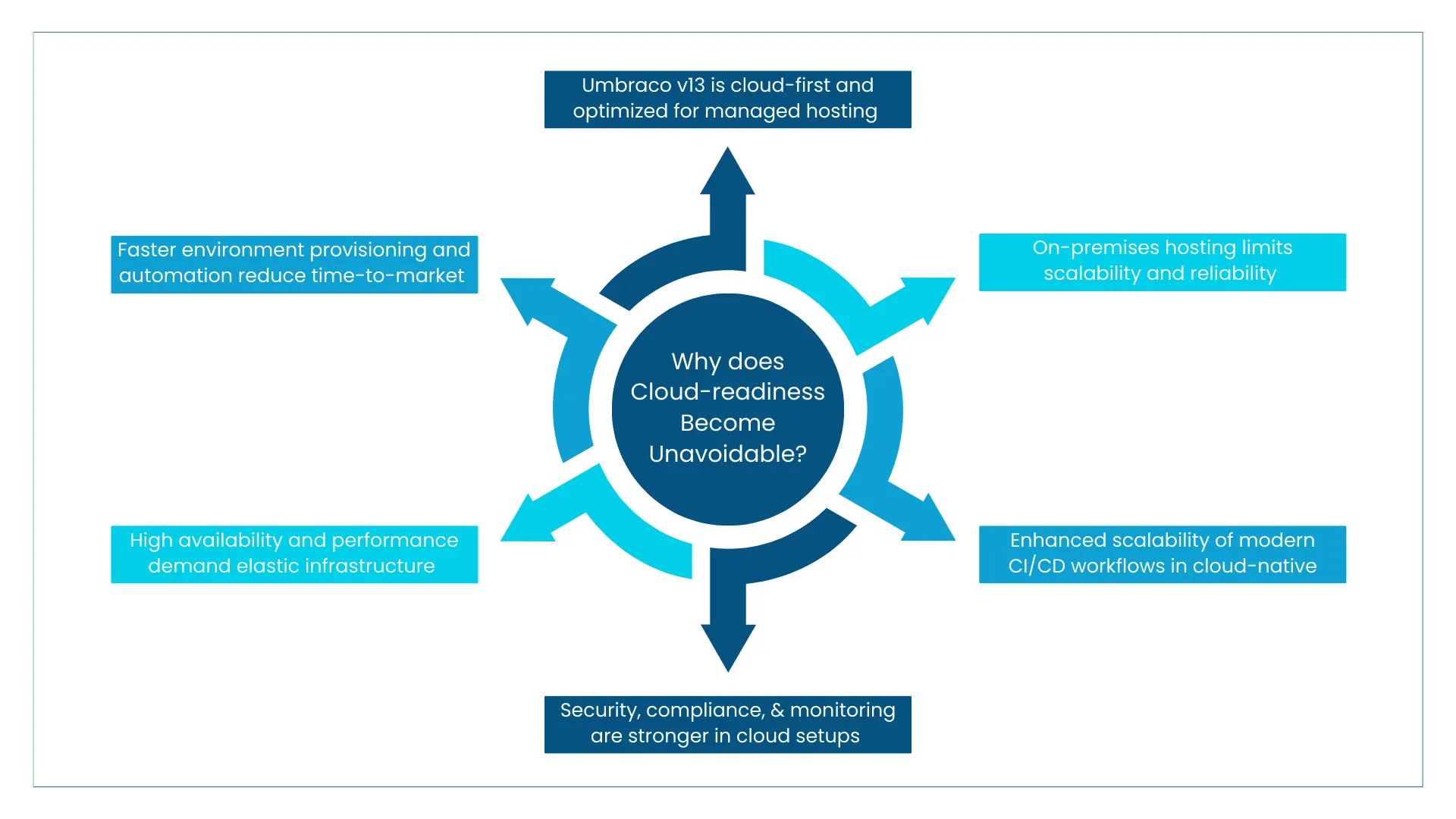
2. Why Was Hosting the Ultimate Step in the Migration Process?
The latest Umbraco cloud features of v13 supported cloud native environments while v8 stood alone with self-managed hosting, which contributed to heavy risk in operations and maintenance. We understood this migration was not just about the codes and the content, but creating a secured, scalable, reliable, and deployment consistency across environments was the vital goal. When aiming for this, our experts knew the infrastructure that supported long-term growth, platform stability, faster releases and upgrades needed to be hosted on Umbraco cloud.
3. Why Umbraco Cloud Was the Natural Next Step
Umbraco cloud features were built on Microsoft Azure, for modern Umbraco versions; it showed native support for Umbraco v13 and future versions. Umbraco cloud eliminates infrastructure and server management in total. This Umbraco cloud feature supports CI/ CD and Git-based workflows, multi-environment setups, seamlessly supports rebuild migration strategy just like we proposed for our client.
4. Umbraco Cloud Features Everyone Swear by:
Sr. No | Umbraco Features | Capabilities |
1 | Fully managed hosting | Excludes server maintenance |
2 | Build-in CI/CD | Automatic build and deployment with Git push |
3 | Git-based workflows | Predictable and version-controlled deployments |
4 | Cloud-native architecture | Built for modern Umbraco workflows |
5 | Automated upgrades | Core updates and fixes are handled automatically |
6 | High availability | Site stays online even at server downtimes |
7 | Scalable infrastructure | Handles high traffic volume effortlessly |
8 | Faster project setup | Pre-configured project foundation |
9 | Security enablement | HTTPS enforcements across environments |
10 | Insights and monitoring | Inbuilt issue detection, resolution and monitoring |
5. The Real Value of Umbraco Cloud After Migration
Post migration from Umbraco v8 to v13 and harnessing the Umbraco cloud features for cloud, it was clear why this migration was the goal. The release cycles became faster with automated deployments, platform stability, reliability, and performance reluctantly improved, provided editors and developers with an enhanced feel; operational overheads and maintenance cost dropped. The new Umbraco cloud features where security and compliance were an inbuilt feature, gained performance even under high traffic.The lower long-term risk for platform or business scalability became an important impact that proved future readiness of the business.
6. Key Challenges Overcome
– Eliminated outdated Umbraco APIs
– Third-party package incompatibilities overcame
– Data loss was avoided while handling NodeId changes
– SEO was preserved and optimized
– Disruption of content and media was avoided
– Unused features were eliminated to enhance migration phases
7. What This Migration Ultimately Proved
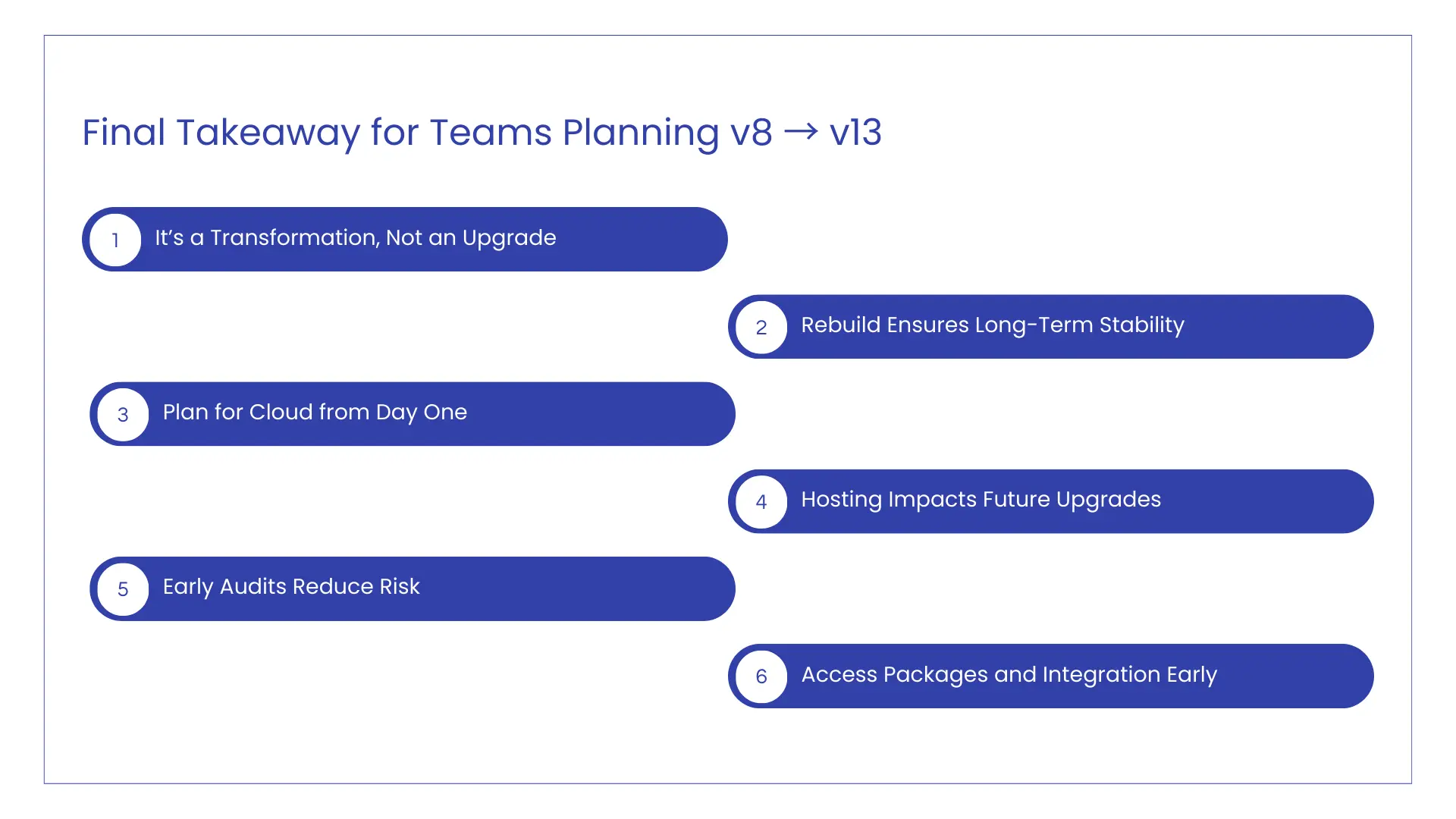
The migration journey started with a decision whether to rebuild completely or partially, and we understood Umbraco migrations are not just about upgrading between versions. Modern Umbraco justified cleaner codes and architectures that make the platform more stable and scalable. Also, the cloud-first and hosting strategy contributed to the long-term success of the platform; automation contributed to speed.At Techxot, over 10 years we have done multiple Umbraco migrations, every migration might sound similar but is very different, each migration has its challenges and impacts post migration which contribute to either technical debt or pushed timelines, thus early planning reduces significant rework and efforts. To conclude, it is safe to say Umbraco cloud is currently the last step in the Umbraco modernization journey.
Client Impact
Faster development and release
Improved platform scalability
Made editorial and developer experience easy
Built future ready foundations
Why It Matters
By the time we finished the migration, the site wasn’t just on a newer CMS — it was on a smarter, self-maintaining infrastructure.
Umbraco Cloud features turned complex deployment and maintenance tasks into a simple, automated process.
Final Thoughts
Migrating to Umbraco v13 on Cloud gave us a future-ready, stable foundation.
The combination of Azure infrastructure, uSync Deploy, and automatic updates means less manual work and more focus on content and performance.
Our migration journey from v8 to v13 wasn’t just an upgrade — it was a full transformation.
Series Conclusion
This post concludes our 5-part series: “Umbraco Website Migration Journey – From v8 to Umbraco Cloud v13 (LTS)” by Techxot.
Techxot is a trusted Umbraco Silver partner, our team has a deep understanding of complex Umbraco cloud workflows, clear proven experience with complicated Umbraco migrations v8 to v13, we propose a full rebuild cloud-first migration approach. We focus on lowering risks through planning and execution, focusing on scalability, stability, and security for the long run success of the platform.
Are you searching for Umbraco partner who is reliable to handle all your complex Umbraco workflows and challenges?
Your search is over.