
1. Introduction
Search is no longer limited to traditional search systems. Where users put a query, the search engines look for exact keywords matches from the query and deliver results. But the AI search assistants and generative search experiences don’t work on keywords; they drive results based on user’s intent.
Users search the LLMs, and they deliver direct and contextual answers as results. This is where Answer Engine Optimization (AEO) becomes important for Umbraco websites. AEO is imposing website structure that promotes information in easiest so the LLMs can discover, understand, and retrieve in order to generate answers.
The major shift between SEO and AEO has gained sustainable significance in Umbraco which can summarized simply as follows:
SEO helps brands get found on the web, while AEO helps brands get understood and answered.
2. What Is AEO in Umbraco?
AEO in Umbraco manages and structures the website content in a way that LLMs easily understand and import information from these websites based on user intent.
For example, instead of beginning an Umbraco services page with multiple paragraphs of random Umbraco development information, having an answer-first approach for content on the page could immediately get fetched by the answer engines.
For example:
“What is Umbraco development?”
Start writing about why businesses use it, what services are available, implementation blueprint, examples, and answerers to more related questions. This content structure makes it easier for answer engines to locate the right answers based on user intent.
3. The 7 Dimensions of AEO
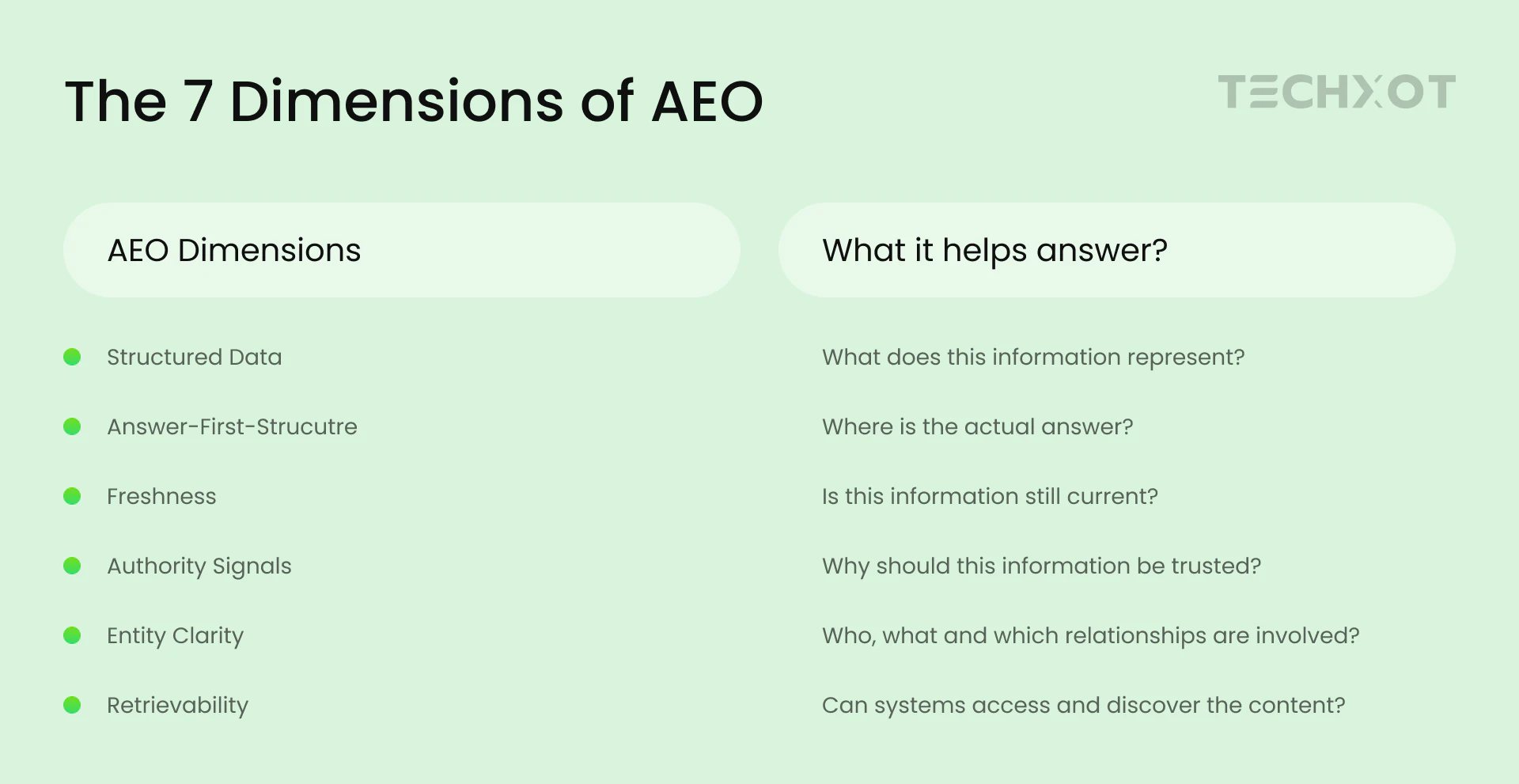
1. Structured Data:
Structured data exposes information about what a particular content on the webpage represents, for answer engines to interpret. The structure data must always be up to date, complete, and validated.
For example,
Take an article about “Umbraco Website Performance”
The article page may contain information like:
Article title
Author
Publication date
Category
This information can be represented using Schema.org and JSON-LD.
An Umbraco article can be identified by JSON-LD:
<script type="application/ld+json">
{
  "@context": "https://schema.org",
  "@type": "Article",
  "headline": "How to Improve Umbraco Website Performance",
  "author": {
    "@type": "Person",
    "name": "Mateen Shaikh"
  },
  "datePublished": "2026-08-20",
  "dateModified": "2026-08-24"
}

</script>
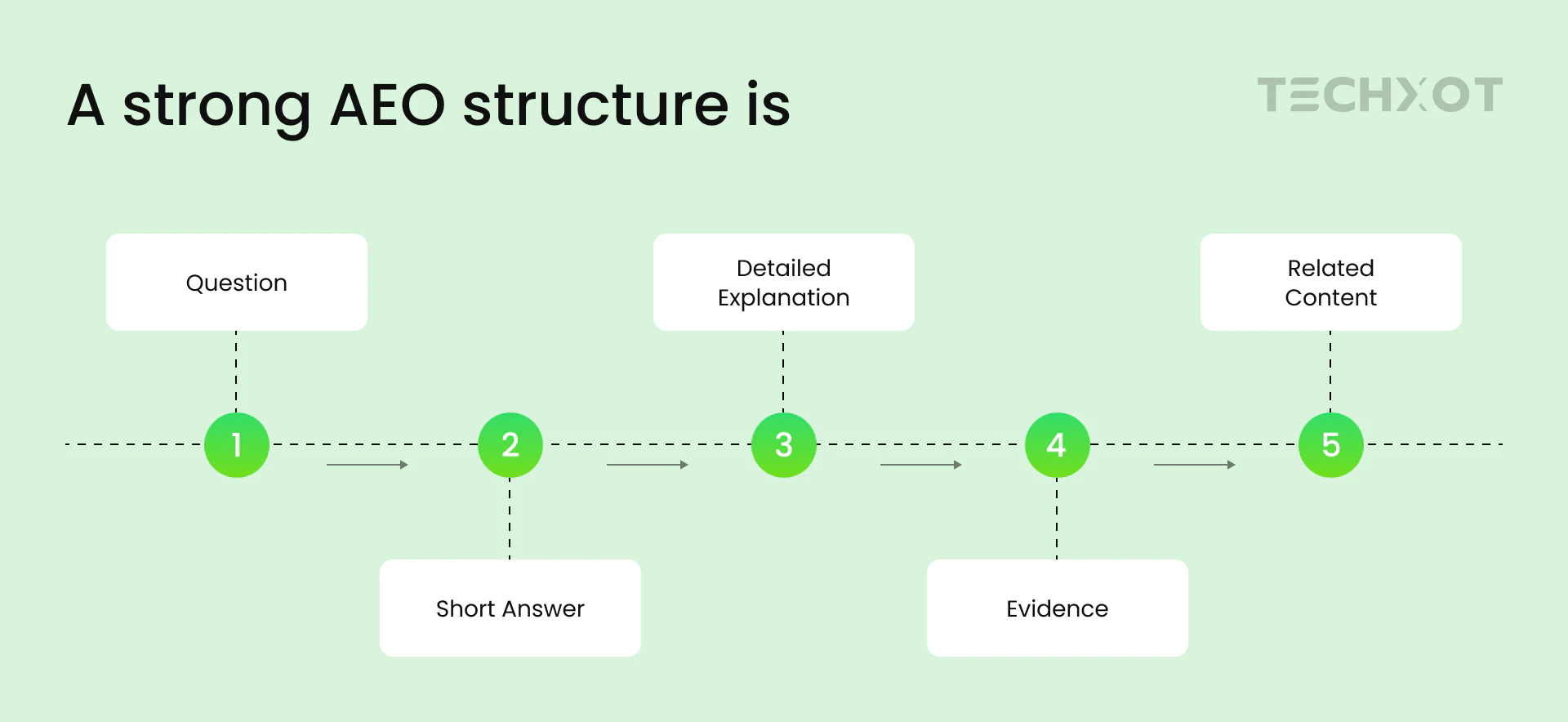
2. Answer-First Content:
AI systems need to identify necessary information efficiently, so always put the answers early.
Instead of starting with the content on webpages with:
"At Techxot, we are passionate about creating innovative digital experiences..."
The page should begin with:
"What is Umbraco?
Following a direct answer to the question before explaining the case studies, features or other related information. This type of content fulfils the user's intent when users are looking for answers quickly.
3. Freshness In Content
Changing a publication date does not make content fresh. Keep posting new and meaningfully current information to keep freshness in the content.
If an article is about Umbraco's latest versions, it should evidently contain information on latest APIs, new features, and case studies. Just changing 2025 to 2026 will not solve the issue.
Meaningful information about the following can involve updating:
Version information
Features and APIs
Integrations
Screenshots
Statistics
In Umbraco, the website content must be in a content lifecycle of publishing, reviewing, updating and continuously auditing.
4. Depict Authority:
AEO doesn’t only make the webpage content answer engine friendly; it searches and displays contextual signal about information and its source.
Enterprise content must have the following authority signals:
Identifiable authors
Implementation experience
Projects
Case studies
Clientele
Third-party evidence where necessary
Brand should try to claim evidence-based expertise, making it a crucial authority signal.
For example,
An Umbraco implementation article must identify:
Its author
Explain relevant project experience
Enterprise brands need to write content that builds trust for AI systems, by proving your expertise and not just writing about it.
5. Entity Clarity
AI systems don't just rely on information demonstrating what an entity is, but also how it is related to the other entities.
Consider depicting entity clarity as follows:
Techxot Software
Is an Organization
Using Umbraco CMS
Operational as an Umbraco partner
Provide Umbraco development services
Located in India
Clearly naming and consistently expressing relationship between entities to build context, rather than repetitively writing about organization and the technology alone.
This step becomes crucial for brands with a variety of services, products, locations, and technologies.
6. Retrieval Ability:
When a well-structure content page is not discoverable to the AI systems, it adds no value and becomes useless. This situation makes AEO significantly overlap with SEO.
So, the enterprise development teams are expected to keep a check on:
HTTP status codes
robots.txt
XML sitemaps
Canonical URLs
Internal links
Redirects
Noindex directives
Rendering
CDN/WAF configuration
Brands must structure their webpages to standards where AI systems can find, render, and access the most updated content version every time.
7. Language and Locale: Give Content Its Context
Language expresses AI systems what a brand is saying. While the Locale tells AI answer engines who the information is intended for.
The same content piece can have different meanings in different markets.
For example:
/en-in/umbraco-services This services page is optimized for Indian markets and may contain information related to INR pricing, local tech terminologies, and necessary Indian specific references.
On the contrary,
/en-us/umbraco-services This services page is optimized for US market and has information about US pricing, US office information, and relevant regional references.
Even though the structure of information may be similar but the context to that information may vary completely.
Locale optimized information must strongly support context to region, pricing, customer references and terminologies.\
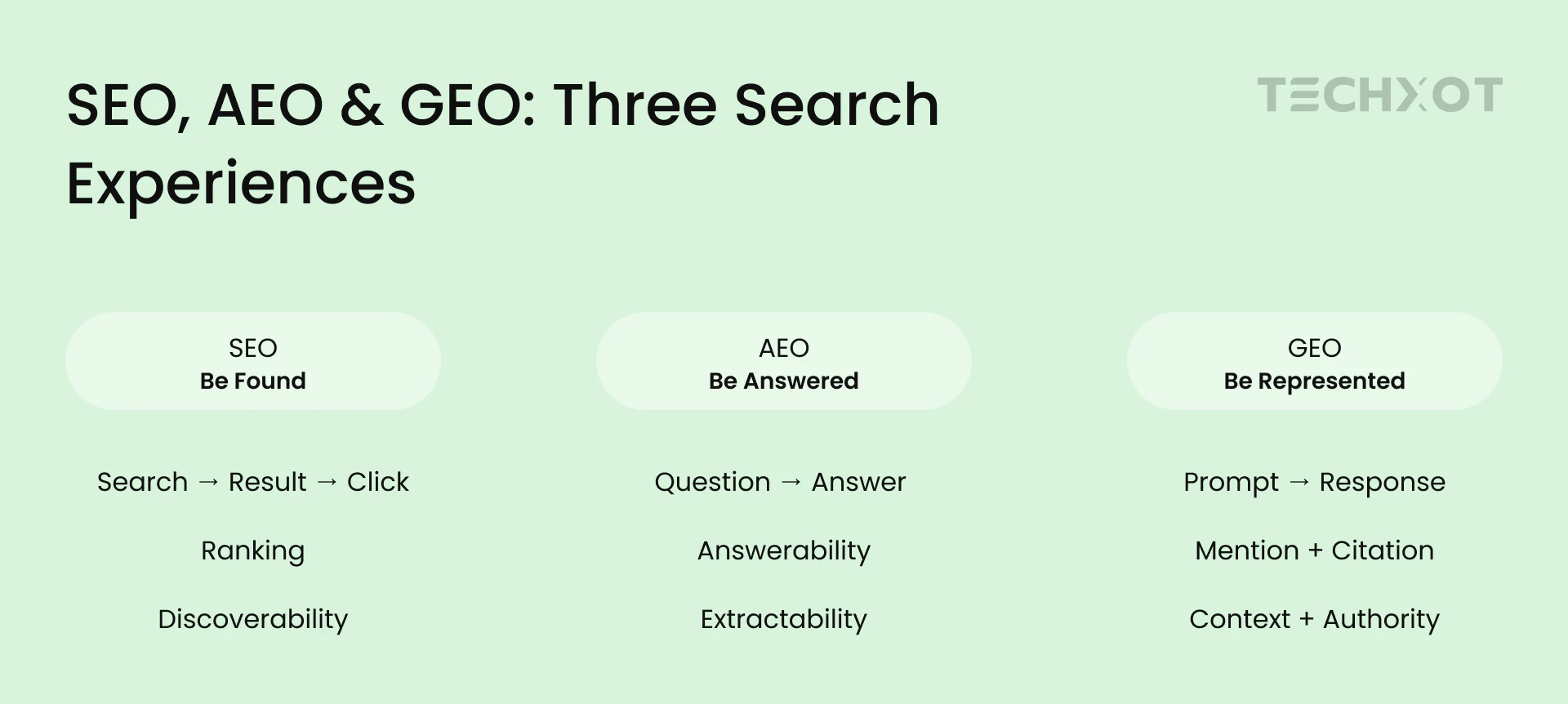
3. SEO, AEO and GEO Work Together
SEO, AEO, and GEO address different aspects of modern search.
SEO | AEO | GEO | |
|---|---|---|---|
Primary goal | Ranking and organic traffic | Inclusion in answers | Mention, citation and visibility |
User journey | Search > Result > Click | Question > Answer | Prompt > Response |
Key focus | Discoverability and relevance | Answerability and extractability | Context, authority and visibility |
Core question | Can people find me? | Can machines understand and answer from me? | Will generative systems represent or cite me? |
These aren't necessarily separate strategies. A technically accessible, well-structured, authoritative and useful page can support all three.
4. Making an Umbraco Website AI-Ready
A practical AEO review should look at both content and technology.
Content teams should review:
Page purpose
Answer-first structure
Factual accuracy
Authorship
Freshness
Entity consistency
Development teams should review
Structured content
Semantic HTML
Internal linking
Crawlability
Rendering
Structured data
Technical signals
The process should not stop after implementation:
Install
Scan
Audit
Improve
Re-audit
This creates an ongoing AI-readiness workflow rather than treating AEO as a one-time optimization exercise.
5. Final takeaways
AEO helps answer engines to interpret and use website information easily.
Answer-first content demonstrates useful information to users and AI systems to find it quickly.
Structured data makes important meaning explicit.
Freshness means updating meaningful content pieces and not just changing dates.
Authority is applicable when expertise has evidence.
Entity clarity helps AI systems understand different entities and relationships between them.
AEO is a continuous assessing process and not a one-time project.
6. Conclusion
The future of search is no longer limited to writing and posting content.
It has become a way to create information that is well structured for the answer engines to discover, interpret, and retrieve for the intended user's query.
AEO is not about writing content for machines.
For enterprise Umbraco teams, AEO sits on the intersection of content strategy, structured data, governance and technology architectures. AEO supports content information that has clear context, has authority, and is accessible to the AI systems.
This has opened opportunities beyond asking whether your website can rank.
Get your AEO readiness assessment for your website today!
Get in touch with Techxot’s most reliable development experts today!