
1. Introduction
Digital assets are not just data that resides in a central library in this AI driven world. Images, videos, documents, product visualizations, brand guidelines, and more are being used to support every stage of the digital customer experience. Businesses with thousands or millions of assets spread out among teams, channels, brands and locations have problems beyond just storing assets. It's a question of whether they are available, dependable, re-usable, controlled, and ready for AI-driven processes.
This is where digital asset management is changed by SitecoreAI DAM. SitecoreAI's content, assets, data, customization and AI features give DAM as part of a connected digital experience platform. Some of its DAM features include AI-powered search and tagging, information enrichment, rights and approval controls, digital experience version management, localization and activation across digital experiences. This means that smart content operations replace asset storage.
This article will discuss how SitecoreAI DAM helps businesses make their information more accessible, intelligible, governed, reusable, and AI-ready by going beyond conventional digital asset management.
1. What is SitecoreAI DAM?
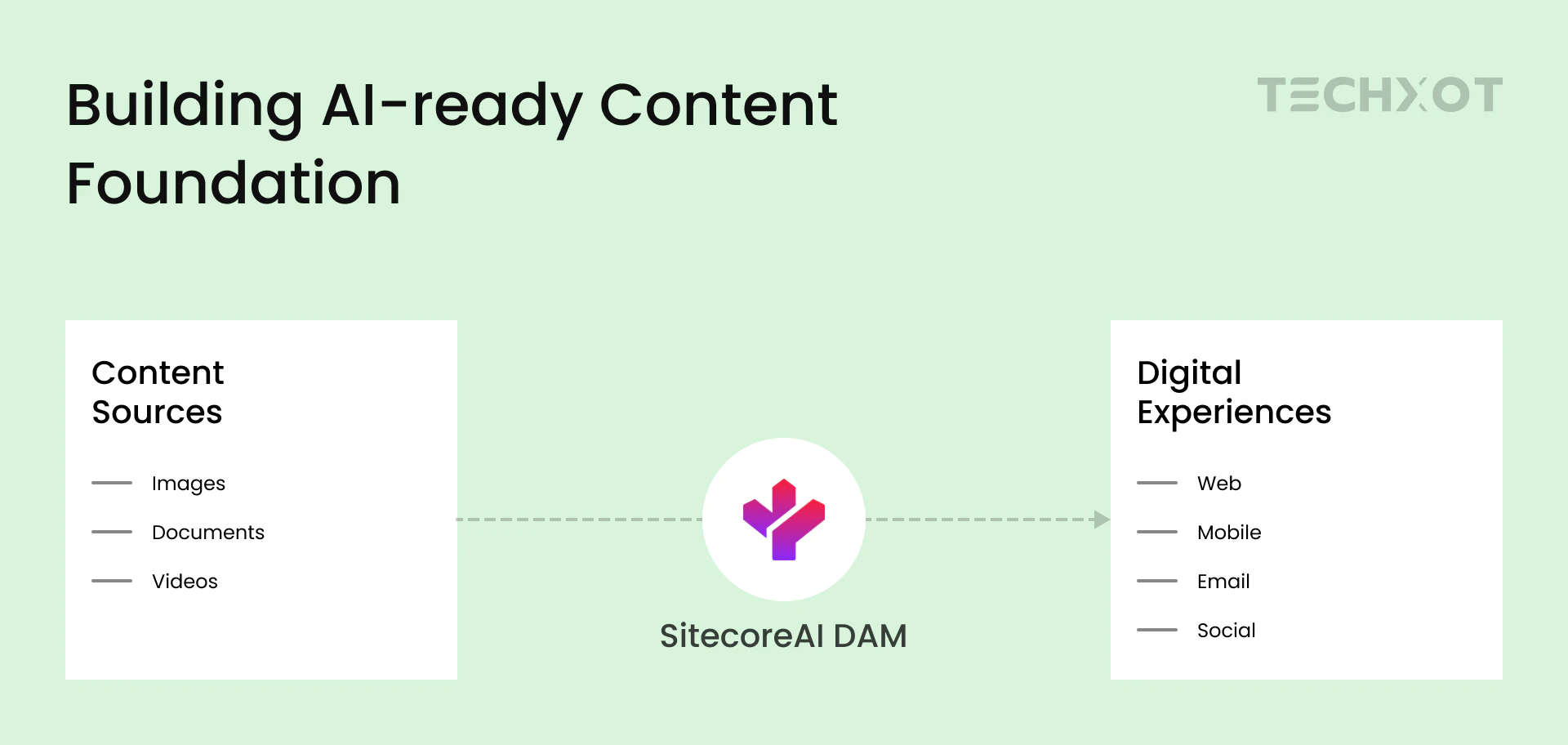
SitecoreAI DAM is a digital asset management solution to maintain, improvise, handle, search, and activate digital assets for businesses. AI-ready content operations could develop into a structured base for DAM, because of its AI-based tagging, metadata enrichment, visual search, copyright tracking and campaign and content connections.
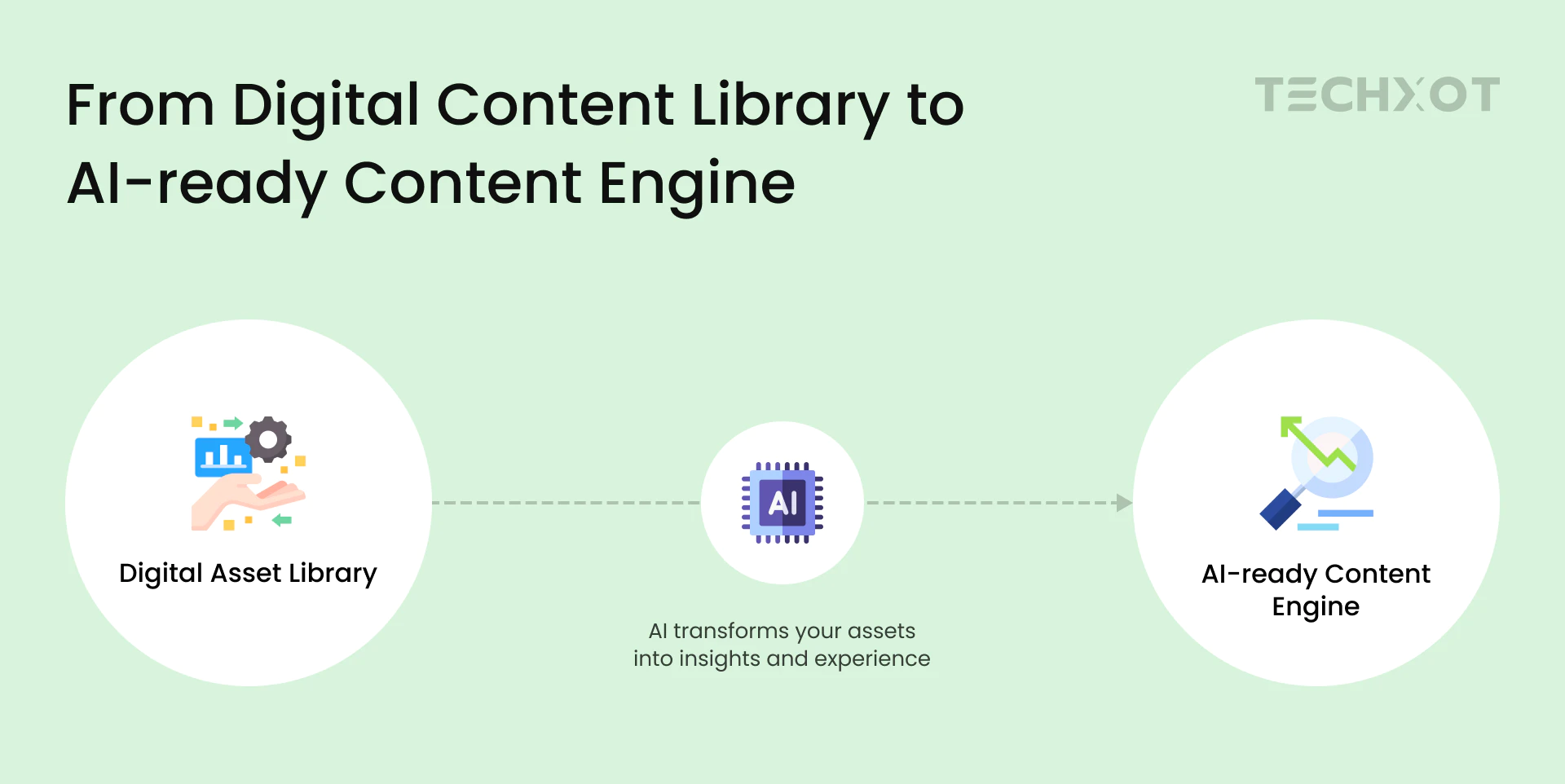
2. From Digital Asset Library to AI-Ready Content Engine
Earlier DAM platforms were used to manage, organize, and store digital assets. Once an image, video, document, or brand file is uploaded, an organization can add metadata, track versions, and then share it with a website, campaign, or other digital channel.
This traditional approach is more difficult to scale, however, when businesses are processing:
Various brands, markets, and geographic areas
Growing volumes of digital assets
Distributed teams and content workflows
Complex approval and governance processes
Different licensing and usage requirements
Increasingly personalized content experiences
AI-powered content creation and delivery workflows
Modern DAM is more than just storing and organizing assets. It understands asset context, ensures governance, finds out usage, and connects content across the digital platforms.
SitecoreAI DAM brings these capabilities together, turning DAM into an AI-ready content engine that helps businesses create reliable, reusable, and valuable content at scale.
See the image below to understand how traditional DAM is evolving into an AI-ready content engine.
3. AI-driven Metadata Makes Assets More Discoverable
Poor metadata is one of the biggest challenges to the proper execution of DAM. Even with a wealth of information for a marketer, if the metadata is missing or the name of the asset is ambiguous, an asset can be difficult to locate. Tags, tagging values, descriptions, and ALT text are just a few examples of the metadata that SitecoreAI DAM uses to improve assets. AI-assisted information enhancement, according to Sitecore documentation, can increase asset discoverability and accessibility while decreasing manual metadata work. This creates a more useful relationship between the asset and the information describing it.
For instance, if you're looking for:
IMG_45892_final_v3.jpg A user can find content that describes an asset, which may help them identify the appropriate asset. Furthermore, SitecoreAI DAM provides visual AI search, letting teams search for content in images or videos instead of the filenames. This is important for both human and AI systems, as the organized context facilitates knowledge, comprehension, and re-use.
4. Content Governance Becomes Part of the Content Lifecycle
Making assets searchable is only one part of the challenge. Enterprise content also needs to be trusted.
An asset may have:
Copyright restrictions
Regional usage limitations
Expiration dates
Approval requirements
Brand guidelines
Version history
Different permissions for different teams
Rights, approvals, version control, access management, and audit data are all integrated into asset management processes by SitecoreAI DAM. This provides an essential idea for content that is ready for AI:
AI shouldn't only be able to access more content. An appropriate stuff should be provided for it.
Businesses can choose which resources are authorized, up-to-date, and suitable for activation with the help of governance.
Additionally, SitecoreAI DAM explains content provenance capabilities for AI-generated assets via C2PA content credentials, giving details about the material's origin and approval status.
This layer of control has grown in significance for businesses that operate in several marketplaces.
5. Connect DAM with the Rest of the Content Ecosystem
When a DAM is integrated with the systems that utilize its material, it generates greater value.
DAM is combined with features like content management and content operations by SitecoreAI. The platform is made to link assets to campaigns, content production, delivery, and personalization.
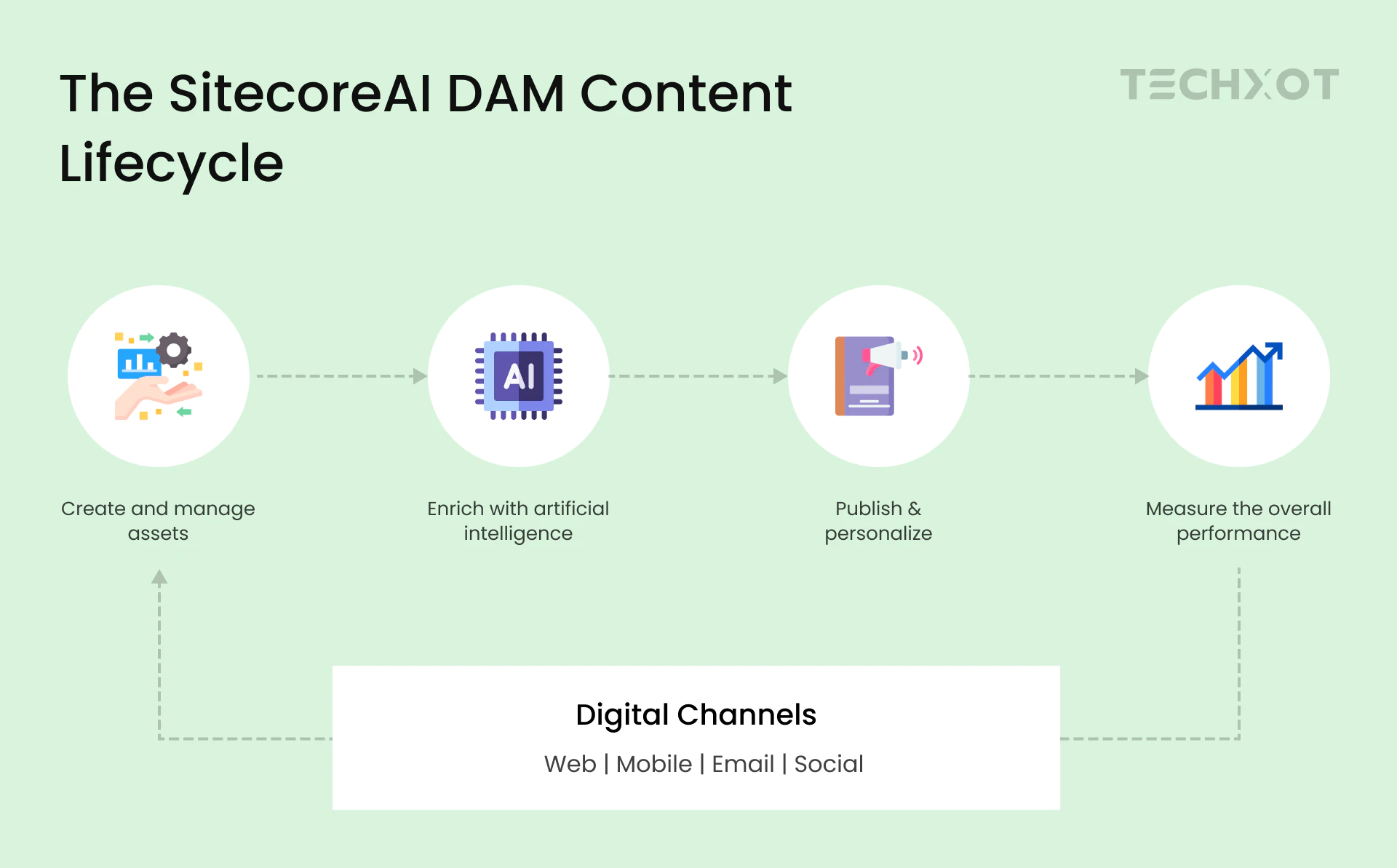
For example, a typical content lifecycle can look like:
Asset creation > DAM > AI enrichment > Approval > CMS > Campaign > Personalization > Performance analysis
As a result, there is less unnecessary movement between disconnected instruments. To integrate Content Hub DAM features with SitecoreAI, Sitecore additionally offers the Sitecore Connect for Content Hub connection.
REST APIs, GraphQL APIs, SDKs, and cloud development capabilities are among the integration options that SitecoreAI offers developers.
This makes DAM more than a marketing repository. It becomes part of the enterprise content architecture.
6. Create an AI-Ready Asset Foundation
AI models are not the first step to AI-ready content. It all starts with structured context and good content. For businesses, this entails laying out the groundwork for assets to have relevant metadata, consistent taxonomies, suitable rights, distinct ownership, precise descriptions, and dependable approval status.
A practical AI-ready DAM strategy should consider:
Foundation | Enterprise objective |
|---|---|
Metadata | Make assets understandable and discoverable |
Taxonomy | Create consistent classification |
Governance | Ensure assets are approved and usable |
Rights | Control where and when assets can be used |
Provenance | Establish content origin and trust |
APIs | Connect DAM with other applications |
AI enrichment | Reduce manual classification |
Analytics | Understand asset usage and performance |
The goal is not simply to make more assets available.
It is to create better-quality content signals that downstream systems can use.
7. Asset Management to AI-Powered Activation
If assets are managed and governed, then they can be utilized as building blocks to build digital experiences which are reusable. SitecoreAI DAM enables asset standardization and localization, AI-driven search, metadata enrichment, and constant activation in campaigns and content.
This can support use cases such as:
Finding the right product image for a campaign
Generating descriptive ALT text
Applying metadata to assets in bulk
Reusing approved assets across regions
Adapting assets for different channels
Connecting approved media with web content
Supporting personalized digital experiences
Maintaining brand consistency across markets
The broader opportunity is to connect asset intelligence with content intelligence. That is where DAM starts contributing directly to enterprise content operations.
8. Getting DAM ready for the AI Search Era
Clear and trustworthy information is becoming more critical for AI-driven search and response systems. On its own, a DAM cannot assure that an asset will be seen by all AI systems or be seen in an AI generated response. But well-organised metadata, good descriptions, easily accessible data, governance and strong links between assets and the surrounding materials lay the groundwork for artificial analysis.
This concept of linking SitecoreAI DAM content with AI knowledge workflows is also growing with Sitecore. Sitecore announced in September 2026 that they had released an early-access integration between SitecoreAI DAM and Sitecore Knowledge Studio that will enable them to convert approved, or “trusted” DAM content into structured knowledge documents for AI grounding.
This illustrates where enterprise DAM is heading:
Digital assets > Structured knowledge > AI grounding > Better digital experiences
The DAM becomes an important source of trusted enterprise content rather than simply a place to store files.
9. Key Takeaways
Digital file storage shouldn't be a modern DAM's only role.
The visual search and AI-powered metadata could enhance asset reuse and discovery.
Governance, rights, approvals, and enterprise content, and provenance are important for reliable enterprise content.
When DAM is connected to Customization, Campaigns, CMS, and APIs, assets become re-usable for content building blocks.
10. Conclusion
It's not just about dealing with more digital content with DAM; it's about ensuring that DAM's future will be shaped by how it helps organizations manage these assets. The objective is to clarify, make reliable, re-usable and ready for ‘smart operation' of those assets. Content management, content operations and digital experience delivery become part of the same larger AI-native platform with the integration of asset recognition and governance into SitecoreAI DAM.
Companies can switch from a traditional asset repository to an AI-powered content engine, where each accepted asset can help with improved content governance, faster content production, better asset search, and more intelligent connected digital experiences. As a Sitecore Silver Partner, Techxot helps companies in optimizing their Sitecore setups and creating scalable digital experience solutions that link technology, content, and business objectives.