
Introduction
In today’s world, enterprise content management has evolved greatly. Right from storing, organizing, and publishing digital resources. In recent times, companies manage content on websites, mobile apps, customer portals, online shopping platforms, and evolving digital channels.
As the amount of content and the customer increases, traditional content management does not keep up. Artificial Intelligence (AI) is changing that reality. Businesses benefit significantly from employing AI in Digital Experience Platforms (DXP) and Enterprise Content Management (ECM) to automate tasks, offer a large-scale customized experience, and manage everything well. AI changes content management from a thoughtless publishing process into a decision founded on the evaluation of the data saved that constantly improves client experiences.
At Techxot, we help companies use AI in DXP to manage the content, to launch the digital experiences faster and drive measurable business outcomes.
Let's see how AI is changing business enterprise content and why it is a must have for modern day businesses.
Why Traditional Content Management Is No Longer Enough
With the evolution of new technologies and taking into consideration our digital-first ecosystem, content has become more than just the information; it is becoming the strong foundation of customer engagement, brand identity, and operational efficacy. Businesses are creating more and more content these days than ever before. Blogs, emails, service pages, audio visuals, social media content, and customer interactions are supposed to be handled by the marketing team over several platforms.
As content requirement increases, a few issues begin to arise:
Finding the right content becomes more challenging
Teams spend too much time on manual tasks
Publishing takes longer than expected
Customer experiences become inconsistent
Measuring content performance gets difficult
Supporting multiple languages becomes tough
Managing content across multiple channels seems challenging
Maintaining personalization and consistency at scale gets difficult
Traditional CMS systems were not built to tackle these problems at a sufficient level. However, AI has the potential to help; by automating repetitive work and transforming content into a business asset rather than just stored information.
The Shift from Traditional CMS to Intelligent Content Operations
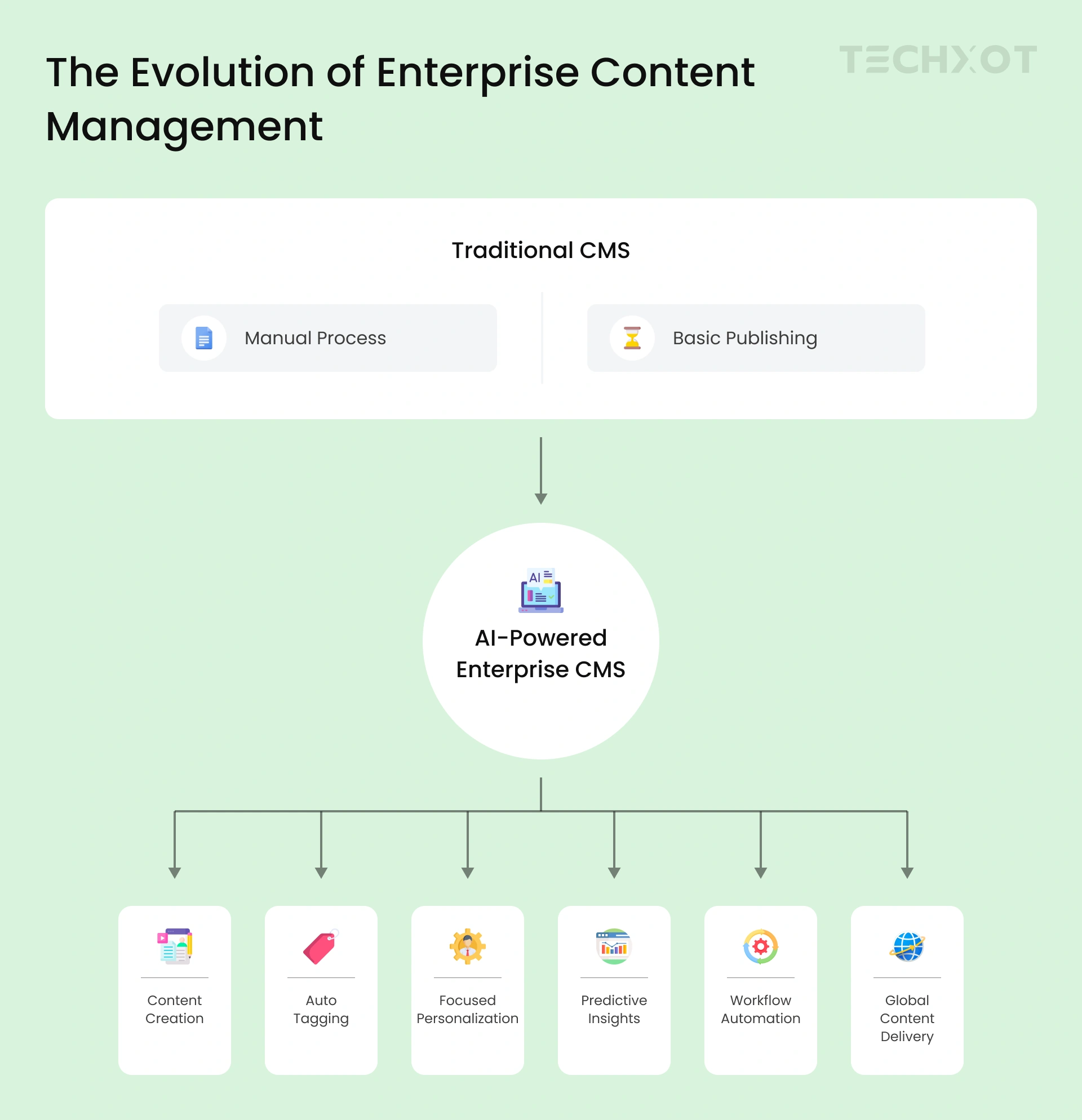
Traditional CMS platforms were designed to create, store, approve, and publish content. They work well for basic content management but often require manual work that can slow down teams and make scaling difficult.
Artificial intelligence is transforming ECM (Enterprise Content Management Systems) from inactive content sources to intelligent content systems. AI is enabling organizations to manage their content more successfully via more intelligent content creation, automated tagging, and hyper-personalized interactions. Also, it supports performance-driven optimization, automates systems, and simplifies the distribution of content globally, locally adapted content. This change is helping marketing executives and content creators to invest less time on manual tasks and more time in developing exceptional customer experiences.
How is AI Improving Content Creation Workflows in Enterprise CMS Platforms
1. Transforming Content Creation Through AI
The integration of AI in CMS platforms makes it easier for content creators to produce more content. Helps them generate content, create drafts, review, rewrite and improve content, provides proper suggestions which helps cut down the time taken to produce quality content. Content can be reused on different platforms easily, allowing teams to produce content on a wider scale without sacrificing quality or consistency. This in turn improves the digital experience of our customers by responding faster and delivering accurate content. Also, reduces human efforts and delays that help businesses to flourish without compromising quality or governance.
2. Automated Tagging, Organization, and Content Discovery
AI simplifies the process of organizing and managing digital assets by automatically generating tags, metadata, and categories depending on the content subject. It improves content organization, boosts discoverability, and eliminates human efforts required to keep huge content storage areas. Natural Language Processing NLP is used by AI to automatically classify and tag content like images, documents, and videos, which makes content discovery easier and can be reused. It also makes content discovery easier with semantic search, that reads human behavior, tries to understand user intent instead of relying on the keywords. AI observes user interactions, search history, and tries to enhance search results and delivers more accurate output. That helps organizations to maximize their productivity and add value to their content.
3. Hyper-Personalized Customer Experiences
Contemporary users expect very accurate and personalized results rather than general information. By integrating Personalization with the best Enterprise CMS Platforms, AI helps businesses achieve this goal by studying user behavior, browsing patterns, purchase record, interests, and choices in real time. Depending on these insights, AI gives personalized experiences to each user, such as product suggestions, offers, and a bespoke customer journey. It also personalizes email campaigns, Virtual assistant interactions, and website experiences so that customers get right data at the right time.
4. Quicker Decisions with Predictive Insights
AI studies user engagement metrics, conversions, search and content consumption patterns, and user behavior, which is completely far beyond traditional analysis and gains deeper understanding. This facilitates identifying which content booms most with their viewers, which channels drive the best results, and where improvements are needed. Also, it predicts future analytics such as future trends, interests, and new content requirements. This eases companies to make proactive decisions, optimize content strategies, and allocate resources more efficiently. To improve results, it also suggests activities like changing poor content, focusing on new audience groups, or revising marketing campaigns.
5. Simplifying Content Workflows and Governance
With AI, complex and time-consuming content workflows have become easy. As, it automates the daily tasks such as workflow routing, approval management, content reviews, version control, and governance checks. This guarantees that content walks through each stage of content development with less human involvement. Helps in overseeing content standards by detecting irregularities, data gaps, policy violations, or regulatory compliance issues before content is published. AI helps teams to work more professionally, uphold content quality and compliance, and improve content delivery by limiting manual effort and avoiding obstacles.
6. Scaling Global Content with Local Relevance
Global content management has become possible with the emergence of AI. Now a days with the emergence of advanced digital platforms it has become possible to serve the global audiences. AI content can be managed and delivered around multiple zones, languages, and cultures. It simplifies this process using advanced translation and localization. With translation, it also modifies content to match up with the local language choices, the culture, regional rules and regulations, and audience expectations while preserving the brand's voice. Enterprises attract international customers, build stronger connections with them, and retain them in the long run, ultimately delivering higher customer satisfaction and loyalty without increasing resources and cost.
Which Enterprise CMS Platforms use AI to Optimize Content Operations
AI is being used by a number of top enterprise CMS and digital experience systems to improve workflow automation, content governance, search, personalization, and content creation. Some important ones are:
Sitecore: Sitecore’s AI services help to render personalized customer experiences, content recommendations, audience insights, and predictive analytics.
Optimizely: Uses Opal for marketers to create, govern, and scale AI agents for content creation, optimization, and workflow automation.
Umbraco: Umbraco offers a flexible, AI-enabled platform that helps teams boost content operations while upholding control, stability, and adaptability.
Progress Sitefinity: Blends AI-powered content organization and personalization to help teams deliver more relevant digital experiences.
Adobe Experience Manager: Adobe Experience Manager is a cloud service that employs artificial intelligence (AI) to help users search for information and create better experiences.
Contentful: The AI-native platform of Contentful makes it simple to deliver experiences that feel customized for every client.
Contentstack: They are the first Agentic Experience Platform (AXP). Offer the combination of CMS, real-time data, and agentic AI.
Kentico: Uses AIRA, its intuitive AI agent, to assist marketers create, optimize, and launch content faster using content and customer data insights.
Conclusion
From the above-outlined article, we can easily say that AI is transforming Content Operations into Enterprise CMS Platforms, such as Sitecore, Umbraco, Sitefinity, Optimizely and many more. Earlier it was publishing focused on the usual process, but now it has transformed into an intelligent system that can automate systems, create content, predict results, and deliver personalized experiences.
AI is continuously refining the quality of content, helping in producing and managing relevant content. Personalization and governance in business CMS platforms help customers to get better digital experiences as per their requirements and build loyalty among the customers. Between the significant advances, automated daily tasks, improved search capabilities, predictive insights, and simplified workflows. Also, allowing businesses to expand their information globally while maintaining local relevance, AI is shaping businesses to a huge extent. That results in improved digital experiences, increased productivity, and customer engagement.
With flexible, enterprise-ready DXP solutions that facilitate smoother launches, smarter decisions, and superior business results, we at Techxot support businesses in unlocking the full potential of AI-driven content operations. Intelligent, automated, and highly customized content management is the way of the future, and it has already arrived.