
Introduction
AI is changing how users find, study about the brands and communicate with them. Customers no longer just depend on a brand's website. Infact, nowadays they don't even visit the website; they try to discover it from Google, an AI assistant, social media, a chatbot, a customized campaign, or an AI-generated response.
Due to this reason, businesses now face a new challenge: how can brands build trust in the age of AI's growing impact over digital interactions and consumer choices?
Digital authenticity is the first element of the process.
Digital authenticity creates digital experiences that are accurate, relevant, transparent, and accountable, and Sitecore's 2026 Digital Authenticity Index highlights these four areas as important dimensions of trust in digital experiences. Sitecore reported that 89% of consumers believe brands should do more to improve their digital experiences.
Therefore, for enterprise businesses, digital authenticity is becoming a crucial element more than a branding thing. It is connected to content governance, customer data, AI, personalization, digital experience platforms, and how brands are seen across AI-powered discovery.
What Is Digital Authenticity?
Digital authenticity, which is the brand's promise to provide reliable, useful, transparent, and accountable digital experiences for the customer to trust. It is more than consistency and reliability of brand messaging, colors, and logos.
AI-driven experiences will work as intended and under proper governance and accountability; the content will emphasize the latest business information; the personalization will be acceptable; and the product information will be credible.
It's not just about effective marketing. Content, information, people, technology, and governance all need to be synchronized amongst themselves. This is specially crucial for corporate enterprises as information is spread across the websites, applications, commerce platforms, customer portals, digital assets, marketing systems, and now even AI-powered platforms.
Why Is Digital Authenticity a Matter of Discussion in the AI Era?
Businesses are now leveraging AI to generate, manage, and publish digital info. AI is constantly reshaping the dynamics of customer engagement; digital authenticity has emerged as a critical element to ensure trust and consistency.
AI relies on business info to generate content and responses.
AI experiences can be misleading if the content is wrong or out-of-date.
Compatible and credible content provides the brand with a more accurate representation by AI.
AI-based experiences create a sense of trust with transparency and accountability for customers.
Well-governed content confirms that brands remain authentic across all digital and AI-based platforms.
The Four Foundations of Digital Authenticity
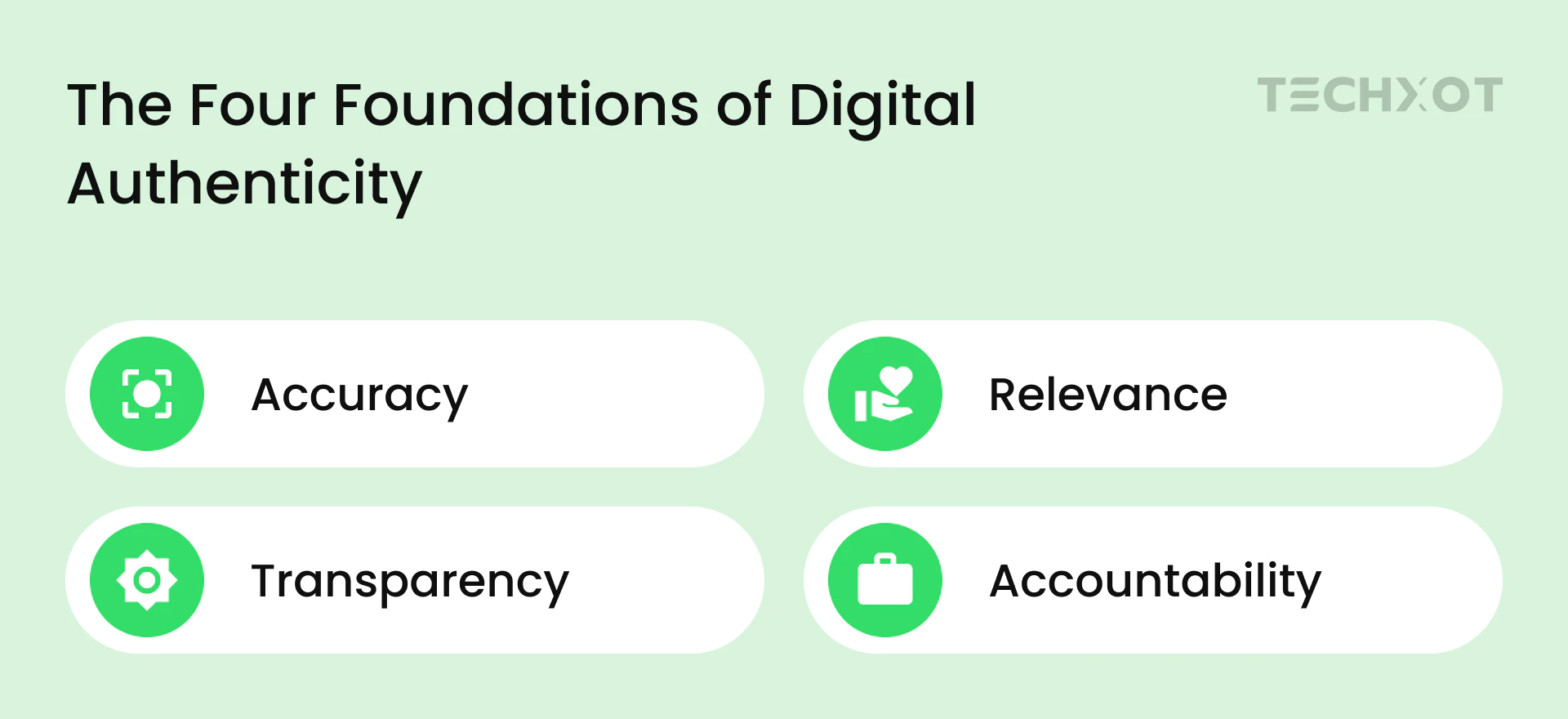
The four areas Sitecore's Digital Authenticity Index identifies for organizations to know where trust can be built on digital points are accuracy, relevance, transparency, and accountability.
1. Accuracy: Make Information Reliable
Customers want brands to give correct information whenever and wherever they interact with them.
This includes:
Product information
Pricing
Services
Policies
Technical specifications
Support information
Company information
Inaccuracies can impact multiple online scenarios in this AI online world, so accuracy is more needed than ever.
Organizations need to define content ownership, review process, workflow approval, metadata standards, and ContentOps. The content operational paradigm should embody accuracy and not merely be the end-of-the-process proofreading.
2. Relevance: Deliver the Right Experience
Users want content and other information that is relevant and apposite to them. Personalization can be a key enabler to deliver more suitable experiences by taking account of the data, behaviour, preferences, and context of a customer's journey. But there must be a reason to be personalized, and if it's not well targeted, it could be off-target and distracting if there's incomplete data. So, enterprise teams should focus on being more responsible and meaningful about personalizing their sites, based on a series of trusted customer data and a consistent set of business rules.
3. Transparency: Make AI Experiences Understandable
Transparency is gaining more popularity in the age of AI that is now an integral part of customer journeys. Users engage with AI-generated content, suggestions received, chatbots or automated experiences, but not necessarily knowing that the content is AI-driven. Each user should have clear guidelines for using AI, creating content with AI, gain access to AI data, review content generated by AI, and experience AI that is customer facing. Transparency is not synonymous with all technical details. It involves the right context and governance over the use of AI.
4. Accountability: Keep Responsibility Clear
Business entities need an owner-oriented structure even if AI helps to ease operations. The team should be able to answer questions such as:
Who gives the green light to AI-generated content?
Who should oversee critical product information?
Who reads sensitive information?
Who is responsible for ensuring the quality of AI-driven experiences?
Inaccurate information reaching customers- who is answering?
Transparency in ownership, approval procedures, governance guidelines, and human supervision promises accountability in a world where AI is becoming more prevalent.
How Digital Trust Is Changing Due to AI
The path is not linear for what a customer takes from the start to the finish. A potential customer could seek information from an AI assistant about a product, compare multiple companies, read reviews from third parties, visit a website, engage with a chatbot, and come back along a different route.
This means that the brand can be represented by AI in front of the customer while they're not yet on the brand's own digital experience. The quality of the content and brand consistency are becoming more significant.
According to AEO's rules, AI systems can take into account information from websites, analyst reports, customer reviews, partner pages, and more when creating answers. It also notes how important it is for the AI discovery process to have clear explanations, clear language, recent data, and verification from outside.
For businesses, digital trust shouldn't be limited to the website. The question is not just any longer:
“Do you think our site is correct?”
It is also:
“Is there accurate, consistent information about our brand out there for customers and AI to access?”
Digital Authenticity and AEO
Answer Engine Optimization (AEO) aims to make the info more accessible, trustworthy and usable for AI-powered Answer Engines that react to customer questions. Thus, digital authenticity and AEO have a strong link.
AEO is not just about trying to get a brand into the answer generated by the AI. It also needs to develop clear, authoritative, up-to-date, and well-managed content that can be properly represented by AI systems.
For example, an enterprise should make clear:
How is it implemented?
What does it provide?
Who is it for?
How does it resolve problems?
Why does it matter?
There should be consistent terminology for content on important pages and external links. Headings, definitions, FAQs, organized information, up-to-date product descriptions, and helpful explanations can enhance readability for humans and AI.
According to Sitecore, AEO is an extension of the basics of SEO, creating clear, connected, well-governed content, with a focus on the possibility of AI-powered search experiences that can understand and even display the content during customer research. It serves as a digital identity and AI-friendliness platform.
The Role of Enterprise CMS and DXP Platforms
Enterprise CMS and DXP platforms are the backbone for handling digital content and experiences at scale.
A modern DXP can integrate the following features:
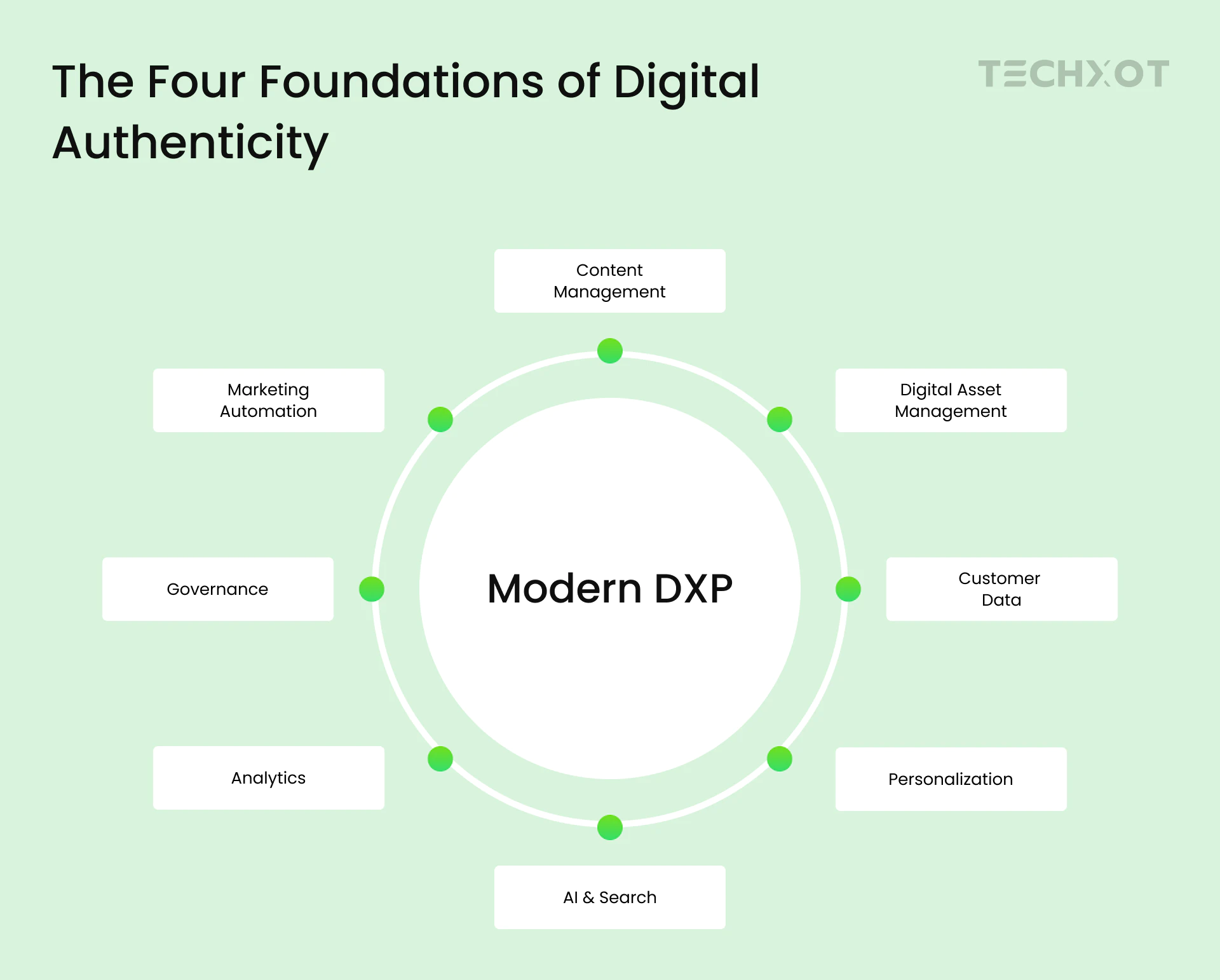
Content management is a key component of Sitecore's DXP guidance, which emphasizes AI readiness and discoverability in addition to content, personalization, data, analytics, and governance.
This becomes a significant link for businesses: Governed content, trusted data, AI-ready information, relevant experiences, and increased digital trust. Technology does not necessarily make the technology authentic. Rather, it offers the systems and processes that a company can implement to help them set up and keep it up.
How to create digital authenticity for brands
There are 5 practical steps that organizations can take to start.
1. Audit High-Value Content
Vet product pages, solution pages, knowledge bases, support documentation, customer resources, and other types of content that affect the purchase. Search for outdated, duplicated, incomplete, or conflicting information and replace them.
2. Set up clear content ownership
Delegate tasks for content creation, review, approval, update, and archiving of important content. Transparency of ownership minimizes uncertainty and maintains information.
3. Strengthen Content Governance
Develop meaningful criteria for:
Content quality
Metadata
Taxonomy
AI usage
Brand guidelines
Approval workflows
Content lifecycle
Data access
Governance needs to be in place to control, but not impede, content operations.
4. Construct for AI Discovery
Develop content that offers easy answers to customer queries. Use descriptive headings, short definitions, structured information, comparison tables, questions and answers, and latest examples as needed. Use the same language in websites, partner content, customer stories, analyst coverage, and other relevant sources.
5. Keep Humans Accountable
AI should be used to help and not replace humans. Identify where human intervention is needed, particularly for sensitive, regulated, financial, legal, customer-facing, or high-impact information. This helps to achieve a real balance between AI efficiency and human responsibility.
Key Takeaways
There are four core principles of digital authenticity: Accuracy, Relevancy, Transparency, and Accountability.
In the era of AI, having reliable content and effective content governance is crucial.
Digital authenticity and AEO are closely intertwined, as the processes of both depend on the existence of clear, reliable and organized information.
Enterprise CMS and DXP platforms can serve as the foundation for many types of governed content, trusted data, personalization and AI-ready experiences.
With the increasing integration of AI models, human supervision remains essential.
Conclusion
AI is revolutionizing content production, customization, and customer engagement for brands. Brands are changing how they create content, personalize it, and engage with customers for the better with AI. Trust is a marketing issue, but it's also a technology and content issue, as the barrier between brands and audiences continues to rise.
This challenge can be addressed in a practical way with digital authenticity, and is stated as accuracy, relevance, transparency and accountability. The opportunity for companies is to establish a digital ground that is governed, one that has up-to-date content, and has established boundaries and limits for the use of AI that are responsible for use.
As AI-powered discovery technology evolves, businesses don't want to be viewed; they want to be understood. As a Sitecore Silver Partner, Techxot enables enterprises to build and grow digital experiences with Sitecore Strategy, Development, AI-powered experiences, personalization, and content management.
AI is not the only factor that will shape the future of the digital experience. It will highlight how the integration of AI, trustworthy content, robust governance, and human oversight can ensure that businesses deliver solutions that clients can trust.