
1. Introduction
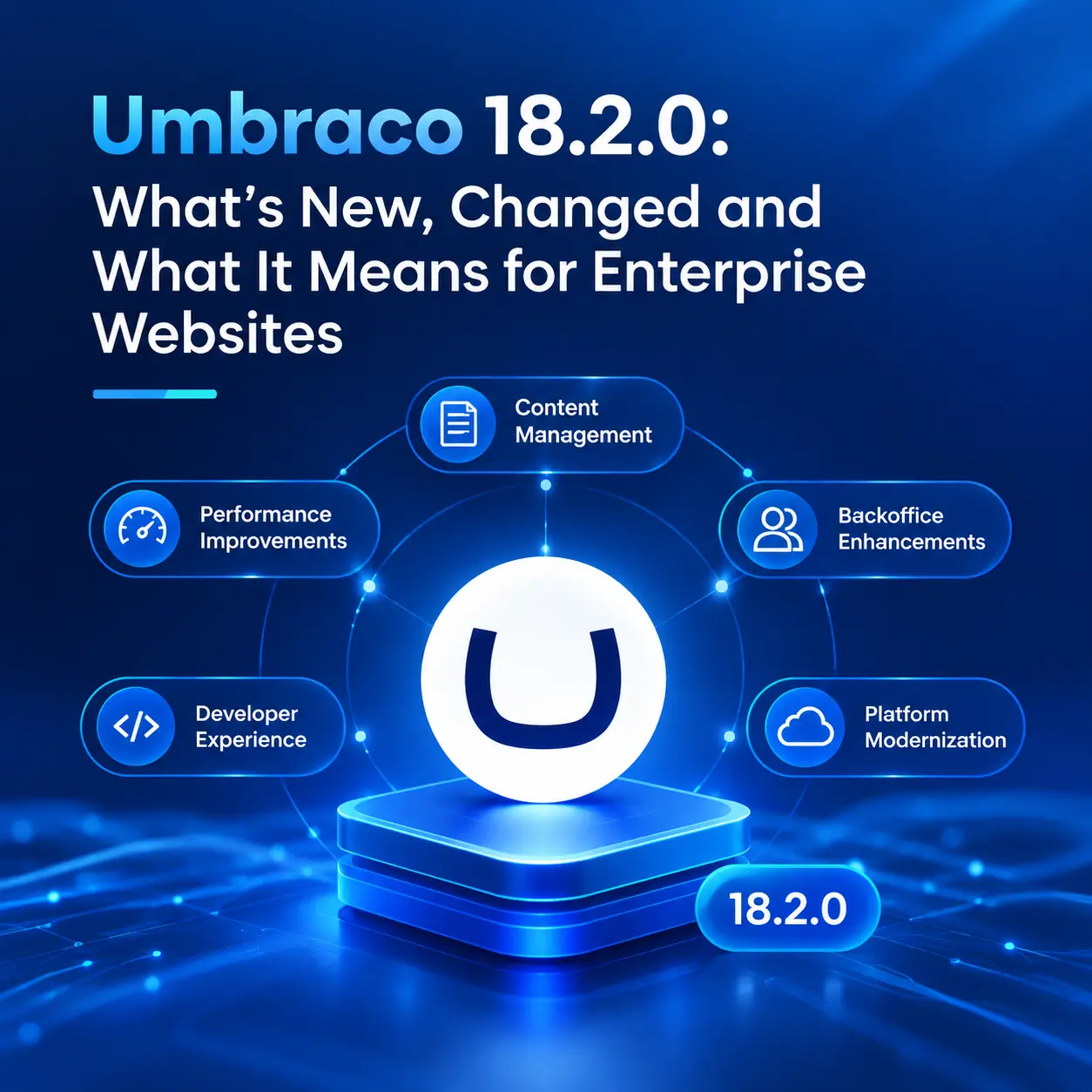
Umbraco 18.2.0 was released on September 17, 2026. The release brings improvements across content management, the backoffice, performance, and developer experience.
For a large organization, however, a CMS release is more than a list of new features.
The more important questions are:
“What Does Umbraco 18.2 Mean for Enterprise Teams?"
Umbraco 18.2 has brought important improvisations across content management, editor workflows, performance, and backoffice. For all the enterprise teams these latest updates are not just addition of new features, but their impact helps teams efficiently manage large content repositories, media libraries, multilingual variation and different complex publishing workflows.
If you are still on Umbraco 13, then it’s time for a version update since Umbraco 13 reaches its End of life on December 14, 2026.
With experience across 30+ Umbraco migrations, Techxot has helped enterprises plan and execute the required Umbraco version upgrades, migrations and development initiatives.
2. What’s New in Umbraco 18.2.0?
Umbraco 18.2 is a version that primarily focuses on elevating the everyday experience of developing and managing larger enterprise websites.
Improvement | Why it matters |
Bulk action progress | Gives editors better visibility when processing large content sets |
Improved pickers | Makes content and media easier to find |
Table and card views | Gives teams more flexible ways to work with content |
Collection improvements | Reduces repetitive editorial work |
Recycle Bin improvements | Gives developers more control over restoration |
Performance updates | Strengthens content, media, and Backoffice operations |
For enterprise Umbraco teams that manage thousands of website pages, media assets, and market and content variations, which improve the daily workflow friction. The Umbraco 18.2 improvements may seem incremental but hold the greatest operational value.
Improved bulk Content Management
Enterprise websites with thousands of pages demand that editors perform similar operations across these thousands of content pieces.
Umbraco 18.2 is the latest release that supports progress feedback for bulk actions like publishing and unpublishing, moving, deleting, or copying content.
The important feature demonstrates the process of large operations instead of having to keep the editors guessing if the CMS is processing the request or not.Why this matters at scale
Consider a global website with thousands of pages across multiple regions. Bulk content operations are not occasional tasks; they can be part of regular publishing and restructuring workflows.
Better feedback does not change the content strategy, but it makes the operational layer more predictable.Improved Content and Media Discovery
As a website grows, finding the right content or media assets becomes more difficult.
Umbraco 18.2.0 improves picker navigation and adds more context to media search results, including ancestor information. It also improves the way editors browse and select content.
For example, instead of seeing only:
hero-banner.jpg an editor can understand where that asset sits within the media structure:
Campaigns / 2026 / Summer / Hero Images / hero-banner.jpg
Why these matters
For organizations with large media libraries and distributed content teams, context can reduce incorrect asset selection and unnecessary searching.This becomes particularly useful when multiple teams work with the same content repository.
More Flexible Content Views
The Document Tree now supports additional ways of viewing content, including table and card views.This gives editors more flexibility depending on the task.
A tree view is useful for navigating a content hierarchy. A table can be more useful when reviewing multiple items. A card view can make visual content easier to browse.
The broader point is that the CMS is becoming more adaptable to different editorial workflows rather than forcing every task into one interface.
Small Workflow Improvements Can Matter at Enterprise Scale
Umbraco 18.2.0 also improves Collections by remembering an editor's view, filtering, ordering and page.
This may look like a small usability change.
But enterprise content operations are made up of thousands of small interactions. Removing repetitive steps from those interactions can improve the overall editorial experience without changing the underlying content architecture.
For digital leaders, this is worth looking at as part of a broader question:
How much unnecessary effort exists in our current content operation?
A CMS upgrade can help enterprises grab opportunities to simplify workflows and eliminate unnecessary complexities developed over time.
Performance Improvements for Larger Content Structures
Umbraco 18.2.0 includes performance improvements in areas such as content traversal, media operations, caching, and backoffice functionality.
For developers working with large content structures, operations such as retrieving descendants can become increasingly important.
For example:
If an enterprise developer manages a large multilingual website, they need to navigate thousands of content pieces, media assets, continuously update multiple language versions, and publish throughout the day. Faster backoffice interactions can make these routine content operations more efficient.
The release-level improvements can help, but application performance should not be attributed to the CMS version alone.
At TechXot, we will look at the wider architecture: content modelling, caching, API usage, search, custom code, integrations, and infrastructure.
This distinction matters because upgrading the CMS does not automatically fix an inefficient digital architecture.
3. Why Should You Upgrade from Umbraco 13 to Umbraco 18.2?
If you are an organization still running your website on Umbraco 13, the decision to upgrade is potentially more immediate for you.
As Umbraco 13 reaches its EOL on December 14, 2026, after this date Umbraco 13 will not receive official security patches and updates from Umbraco HQ. This also doesn’t mean that your enterprise websites will crash overnight.
Umbraco identifies Umbraco 17 as its LTS and officially supports till November 27, 2028. If enterprise teams don’t start planning their Umbraco migration from 13 to higher versions like Umbraco 17, 18, and 18.2, it can pose serious security risks.
Enterprises still on an Umbraco 13 implementation should also consider:
Current custom code
Third-party packages
Content architecture
Integrations
SEO dependencies
Hosting and infrastructure
Long-term product roadmap
Umbraco provides a direct LTS-to-LTS upgrade path from Umbraco 13 to Umbraco 17. Techxot, as an Umbraco implementation partner, can implement this version upgrade for you.
The practical takeaway
If your enterprise Umbraco implementation is on Umbraco 13, then the best next step is to assess whether you need an upgrade or rebuild.
This assessment clarifies whether the current solution is better for an upgrade, a selective or complete rebuild, or broader platform modernization.
4. What Should You Audit Before an Umbraco Upgrade?
For an enterprise implementation, six areas deserve attention.
Custom Code
Review controllers, services, composers, APIs, and custom backoffice extensions.
Packages
Check whether third-party packages support the intended Umbraco and .NET versions.
Content Architecture
Review document types, Block Editors, media structures, multilingual content, and property variations.
Integrations
Map dependencies such as CRM, search, commerce, forms, analytics, and external APIs.
SEO
Protect existing search value by reviewing:
URLs · Redirects · Metadata · Canonicals · Sitemaps · Structured Data · Robots.txt
Infrastructure
Review hosting, database, CI/CD, caching, environments, and deployment processes.
5. Key Takeaways
Umbraco 18.2 was released on September 17, 2026.
The release improves content operations, editor workflows, navigation, and performance.
Umbraco 17 is currently the latest version, while Umbraco 18 is STS.
Umbraco 17 and 18 both use .NET 10.
Umbraco 13 reaches End-of-Life on December 14, 2026.
An Umbraco 13 migration should begin with an architecture and compatibility assessment.
For enterprise websites, an upgrade can be an opportunity to address technical debt, SEO dependencies, and inefficient content workflows.
The right migration strategy depends on the existing solution and the organization's longer-term digital roadmap.
6. Conclusion
For an enterprise website, an Umbraco upgrade should not begin with:
“Which version should we install?”
It should begin with:
“What does our digital platform need to support over the next several years?”
This assessment can identify the right Umbraco version, migration approach, and modernization priorities. Choosing the right Umbraco implementation partner can help you migrate to newer versions or help with a complete modernization approach.
Techxot helps organizations assess, modernize and migrate Umbraco implementations, according to the architecture, content, integrations, SEO and long-term maintainability.