
AI is actually changing the way people look for information, engage with the brands and communicate with digital content. The way in which enterprises manage and provide their digital assets is changing because AI is has become an integral part of the customer journey.
Websites and marketing elements are not just the only places where brands use pictures, visuals, documents, and other brand resources. They are able to manage automated content workflows, personalization, and AI-driven discovery.
So, having a large digital asset library is not enough to be ready for AI. Assets must have significant metadata, rights that are easily understood, solid approval mechanisms, and enough context to guide humans and AI to determine which assets are suitable for a specific use.
The central theme of the second session in Sitecore's DAM Readiness in the Age of AI Visibility webinar series was John Horodyski, Managing Director at AVP, and Matthew Noyes, VP of Product Marketing at Sitecore. One of the key points raised was that AI cannot just locate an asset; it needs to be done more. It requires sufficient context to determine whether it is relevant, approved, and appropriate for the use it was created for.
Let's take a look at the major factors to consider when creating an AI-ready Digital Asset Management (DAM) for Sitecore.
What Is AI-Ready DAM and Why Is It Important for Enterprises?
AI-Ready DAM is a digital asset management platform that is created to be Concordant with AI tools. Structured DAM is a system leveraged for integration with AI tools.
Traditionally, DAM let organizations store, organize, retrieve, and publish their digital assets. An AI-ready DAM makes assets easily discoverable and can be used in linked content workflows.
Imagine a multinational corporation with thousands of marketing materials, campaign films, and product photos. An employee may know the correct image for the campaign right away. But an AI system requires enough information to understand the image's intent, audience, clearance, and restrictions.
Key Challenges in Enterprise Digital Asset Management
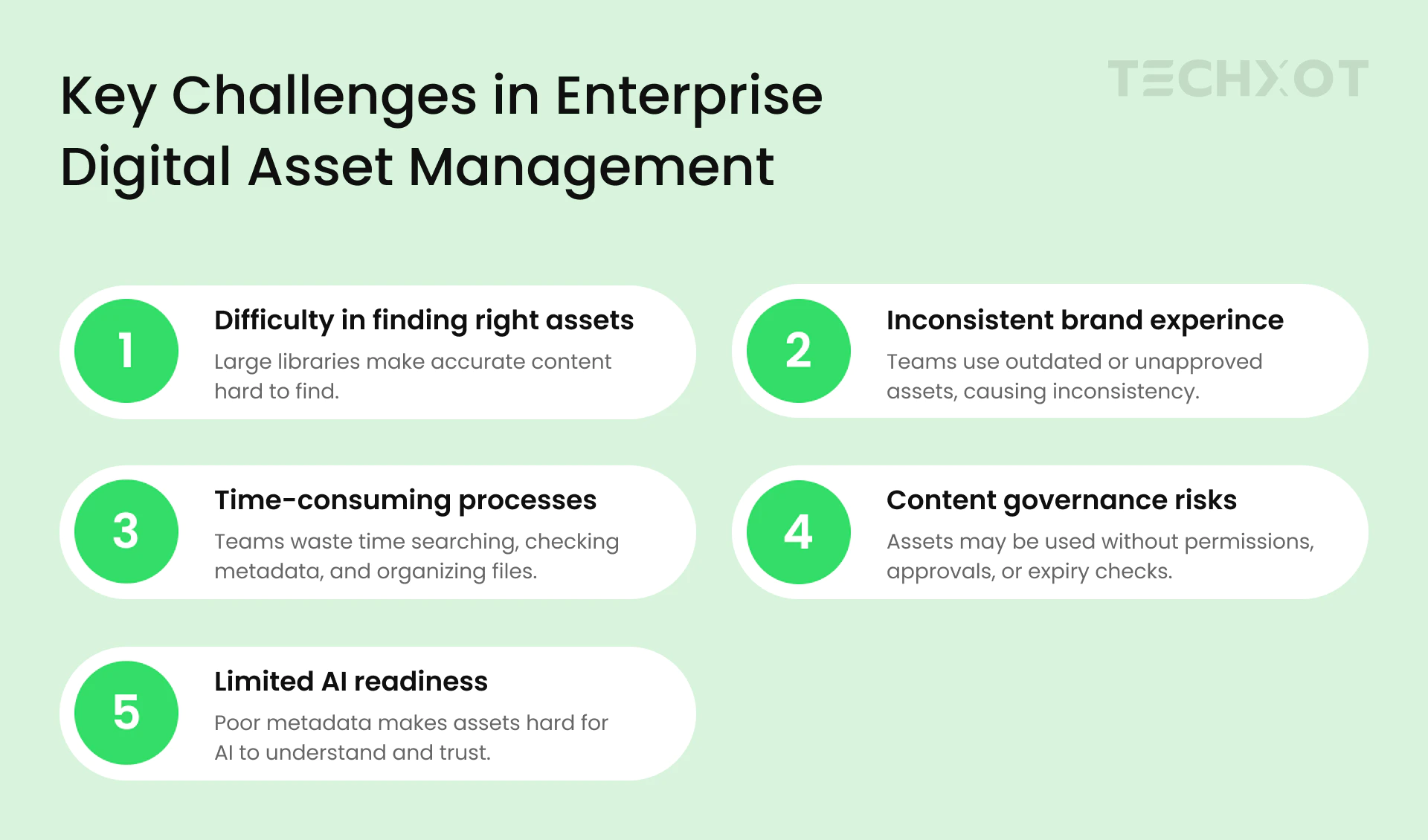
Content readiness is the first step to making an AI ready organization. First, companies should have a strong platform to handle and make use of their current digital resources before adding AI features.
Metadata and Taxonomy: Helping AI Understand Assets
Metadata is the description of an asset, and taxonomy is a system for organizing and categorizing metadata. Recognizing an asset is the first step in the process. It is also important to know what it is and how it should be used.
The image of a product could consist of:
Name and category of the product.
Brand and campaign
Target audience
Country or region
Language
Approved channels
When using this information, the employee can search for assets based on their purpose and not just the asset file name.
When deciding whether necessary assets might be used for a specific task, this offers prior knowledge about the assets. AI-powered tagging and improved metadata eradicate the need for traditional classification. Yet, companies should look at automated suggestions in instances where accuracy, consistency of brands, and compliance are most important.
The purpose is not to apply as many tags as possible. The main goal is to confirm that there is a regularity and meaningful metadata that improves the capabilities of asset discovery, reuse, and trust. And it should be looked at, at least three times a year.
Governance: Helping AI Identify Trusted Assets
Although a particular asset might be readily available, it might not be appropriate for all purposes.
An item image may be approved for one campaign but not for another market. The promotional video could be out-of-date. There may be a newer version of a document.
These are details that are important when content operations go to AI.
The following areas should be part of a good DAM governance framework:
Approval management: Clearly identify assets approved for use.
Proper use of rights: Record copyright, licensing and usage prohibitions.
Expiry management: Determine assets that are not valid or approved.
Localization: Ensure that the asset versions are in line for various markets and languages.
Access controls: Set up users to view, edit, approve and share assets.
Ownership and accountability: Set up responsibility to keep asset information.
The company might never be able to determine whether an asset is appropriate for a certain campaign or customer experience if all these controls are not in place. By making asset status, authorization, and duties clear, governance may reduce confusion.
The objective is not to provide all the assets for AI. It is to make sure that the appropriate assets are found and utilized in appropriate situations.
Link DAM Throughout the Content Supply Chain
DAM value increases when it is connected into a networked content system as compared to being a stand-alone file storage. A company content goes through a few steps as mentioned below:
Generation
Review
Approval
Localization
Publication
Distribution
Performance monitoring
When these processes are done again and again in separate systems, teams need to rework, manually transfer data, or continuously check asset condition.
The Sitecore DAM integration with appropriate content systems and workflows can help to reduce these gaps.
Let's suppose a business is planning to promote a regional marketing campaign. The team must locate an approved product image, check the usage rights, choose the right localized image, and link it to the content on the websites.
A connected workflow ensures that this information is retained when the asset goes into content management and publishing.
This method can be used to aid:
Greater consistency in asset re-use by channel and region.
Improved tracking of approval and usage.
Less manual workload for content operations.
Better integration of marketing and content and tech teams.
More reliable activation of authorized assets.
Implementing an integrated digital asset management solution within the Enterprise Digital Asset Management workflows can benefit organizations by enabling a more cohesive content supply chain between content management and content delivery workflows.
The goal is to more easily identify, re-use, and activate approved assets if required.
How to Assess Your DAM Readiness
To expand AI use, enterprises must know if their existing DAM environment is suitable for the foundation. A readiness assessment can focus on areas of poor content quality, governance, asset organization, and system integration.
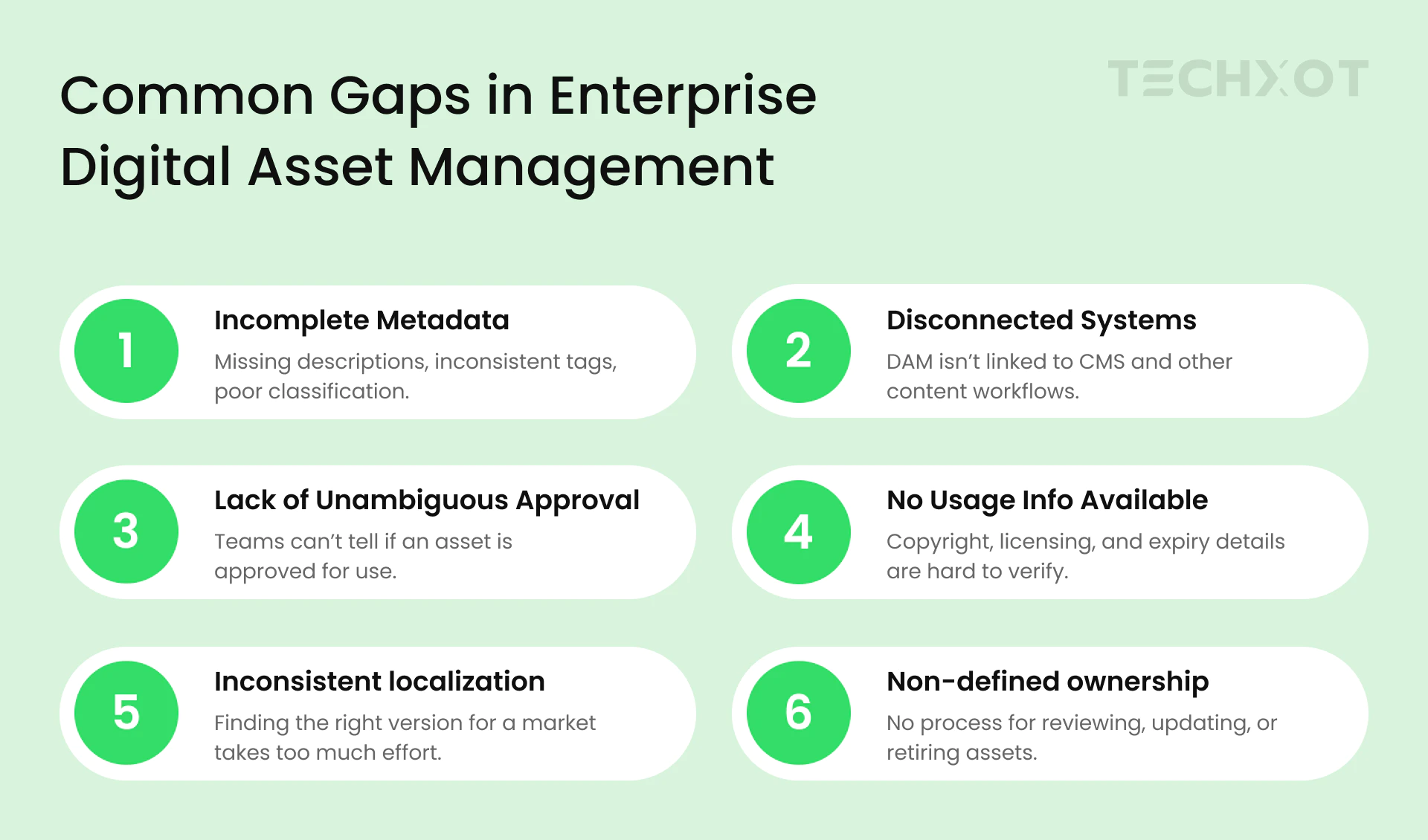
These gaps can make delays, lead to rework, and make it difficult to use digital assets in a reliable way. Organizations should first assess existing processes, content quality, governance controls, system connections, etc., before performing to upgrade their technology.
This will give a clearer direction of where changes are required, and which changes to prioritize.
A Functional Structure for Developing an AI-Ready DAM
It is not always necessary to replace the platform to prepare DAM for SitecoreAI. It's important to begin with building on present content.
Step 1: Audit existing digital assets
Go through the asset library, find duplicate ones and frequently used assets, and know how assets are currently structured.
Step 2: Work on metadata and taxonomy
Give consistent naming, metadata, and discovery rules. Look at it at least three times a year and improve it.
Step 3: Strengthen governance
Apply permissions, ownership, controls, and expiration of controls and policies.
Step 4: Connect Content Systems
Integrate DAM with other systems, such as CMS platforms, publishing tools, and translation workflows. This helps teams use the right assets without moving files manually from one system to another.
Step 5: Find Ways to Use AI
Start with simple tasks where AI can help, such as finding images, adding tags, organizing files, and preparing content for use.
Step 6: Check and Improve
Always check whether assets are easy to find; their details are correct or not, and whether rules are being followed. Also, look for tasks that take too much time and find ways to make them easier.
By following these steps, businesses can prepare their existing DAM for SitecoreAI while keeping their content organized, accurate, and good to use.
From DAM Readiness to Better Digital Experiences
The AI-ready DAM can offer much more than traditional asset management. It supports organizations to give more consistent, appropriate, and connected digital experiences.
If there's important metadata, a reliable source for approval and obvious connections to neighboring content, teams can then reuse assets with greater confidence in campaigns across websites and markets.
This will enable more rapid content discovery, uniform brand experiences, content operations that are optimized, more personalization, and better control of the content use of AI.
However, these results will only show up if implementation is of good quality, if systems are connected, and if governance is correct. AI cannot solve the issue of missing context, lack of clear usage rights, or different content processes.
The true potential is connecting AI features with organized content, assured administration, and linked processes.
In a previous blog, we gave an overview of how AI can make digital assets more manageable and easier to find for businesses, SitecoreAI DAM: How Enterprises Can Transform Digital Assets into an AI-Ready Content Engine.
But having AI tools is not enough. Well-organized files, proper information, permission to use files, and approval process must also be well-documented in businesses. These steps assist teams in identifying the appropriate assets and utilizing these assets safely.
As a Sitecore Silver Partner, Techxot has the expertise to optimize businesses' Sitecore platforms and build a better digital experience.