
Introduction
Sitecore implementation is a major milestone for enterprises who are looking to improve digital experiences, improve content management, and deliver personalized user experiences and journeys. Even though Sitecore implementations are complex with proper planning, businesses can take brands faster-to-market, avoid budget overheads, increase platform adoption, and better return on investments.
The real challenge is never the platform; most of the implementation issues are lack of planning and execution mistakes.
Let’s explore Sitecore implementation pitfalls and how to avoid them.
Sitecore Implementation Pitfalls and How to Avoid Them
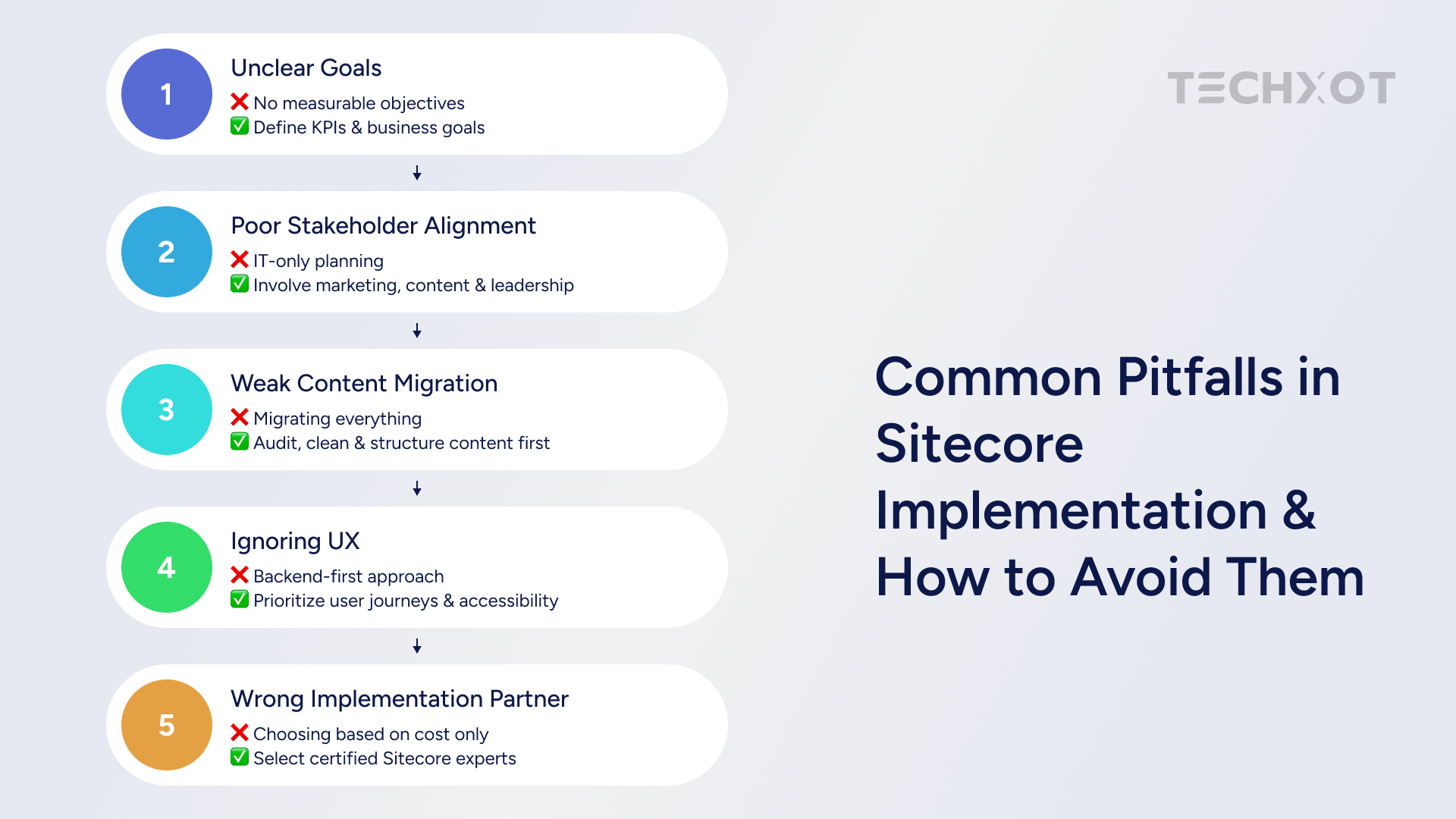
1. Lack Of Clear Goals and Business Objectives
Most organizations tend to make some of the most common mistakes at the beginning of Sitecore implementation, not setting clear and defined goals. Enterprise teams always broadly start with setting up goals like improving customer experience, revamping and modernizing the website, or just enabling personalization for brands. Even though these goals are useful, they don’t align with measurable key performance indicators.
When teams miss this important step of setting goals, the project may experience misaligned priority to tasks, budget overheads, and lost scope.
How to avoid this pitfall:
It is important teams define measurable objectives like:
Reduce content publishing time by 35%
Increase leads by 25%
Increase website conversion
2. Underestimating stakeholder involvement
When an organization decides on Sitecore implementation, it should be understood that it is not just a simple upgrade initiative. It affects all departments like marketing, content, development, and customer experience teams, thus not involving all teams and stakeholders at the early stages. It can often cause enterprises teams to face misaligned requirements, lots of rework, delays and challenges in adoption of post launch.
How to avoid this:
Enterprise teams can avoid this important pitfall by:
Including marketing, content, IT and leadership teams from the starting
Collect campaign and personalization requirements
Create appropriate workflows and governance
Teams should carry out regular project reviews to help maintain alignment and accountability of business executions.
3. Poor Content Planning and Migration Strategy
Content migration is one of the most important aspects of Sitecore implementation but also the most underestimated one.
At time enterprises tend to migrate legacy content to Sitecore without auditing the quality of it. This may result in compromised relevance, duplicate content, outdated assets, SEO issues, and poor quality.
How to avoid this:
Conduct a thorough content audit for migration which may include practices like:
Cleaning older assets
Standardizing metadata
Defining new content models for migration
Post migration into Sitecore, content quality should improve and not carry over existing risks and problems to the migrated platform.
4. Ignoring user experience
Not every Sitecore implementation is successful; it can fail if the user’s experience is poor. A poor user experience is the one with poor navigating structure, no mobile responsiveness, poor accessibility, and missed personalization and relevance to the users.
When an enterprise brand has poor user experiences, it instantly decreases engagement and negatively impacts conversions.
How to avoid this:
Development teams should prioritize user experience by:
Conducting user research
Mapping user journeys
Proposing valid wireframes at the beginning
Test for multiple devices and browser
Sitecore enhances digital experiences, and user experiences should always be the most vital implementation at the start.
5. Inadequate Architecture Planning
When architectures are not planned efficiently, they can create technical debt that can sabotage long-term scalability. An inadequate architectural solution can introduce issues like poor integrations, security and governance vulnerabilities, limited scalability and performance bottlenecks.
These risks come when enterprises are integrating Sitecore with CRM platforms, ERP systems, marketing, and automation tools.
How to avoid this:
Architectural planning is a step that needs sound attention very early on the Sitecore implementation execution. Every enterprise must focus on infrastructure requirements, dependent integration, cloud readiness, security and governance, scalable planning to choose the right solution architecture for your requirements.
6. Insufficient Training
Organizations invest in platforms but neglect training, which may bring editorial struggle with workflows; teams don’t adapt to platform features; governance can be bypassed.
How to avoid this:
Create relevant role-specific training for content teams, marketing teams, admins, and development teams. Enterprises need to train teams for documentation, governance guidelines, and other support resources. The Sitecore implementation success is dependent on strong adoption after launch.
7. Choosing The Wrong Implementation Partner
Choosing a wrong implementation partner can be the primary reason your project can fail. A lot of times organizations choose platform vendors based on lower costs quoted, generic CMS experience, and vague delivery promises. Vendors like this drive project towards failure because lack of expertise in execution decision like choosing poor architectures, missed timelines, continuous rework, weak post launch adoption and support.
How to avoid this:
Choosing the right Sitecore implementation partner who tends to have executional and implementation capabilities can ensure the project turns into a success. The right implementation expert will always function as a strategic long-term advisor. Choose a partner with proven platform experience, certified expert teams, strategic consultation ability, and valuable post launch support.
How to Choose a Certified Partner for Sitecore Implementation
Look for the following capabilities when choosing the right implementation expert for your project:
Platform Expertise:
It’s is important the implementation teams has
Certified Sitecore experts
Solution architects
Execution specialists
Proven Experience:
Ensure they have:
Enterprise case studies
Industry specific deployments
Migration & integration experience
Strategic Consultation:
A strong implementation partner should support in multiple stages of decision making like:
Discovery workshop
Data architectures
Personalization planning
Governance strategies
Post Launch Support:
Look for valuable support services like:
Maintenance services
Performance monitoring
Post launch optimization
Investing in the right Sitecore implementation partner will bring your enterprise the experience, expertise and strategic advisory that will drive the platform execution success.
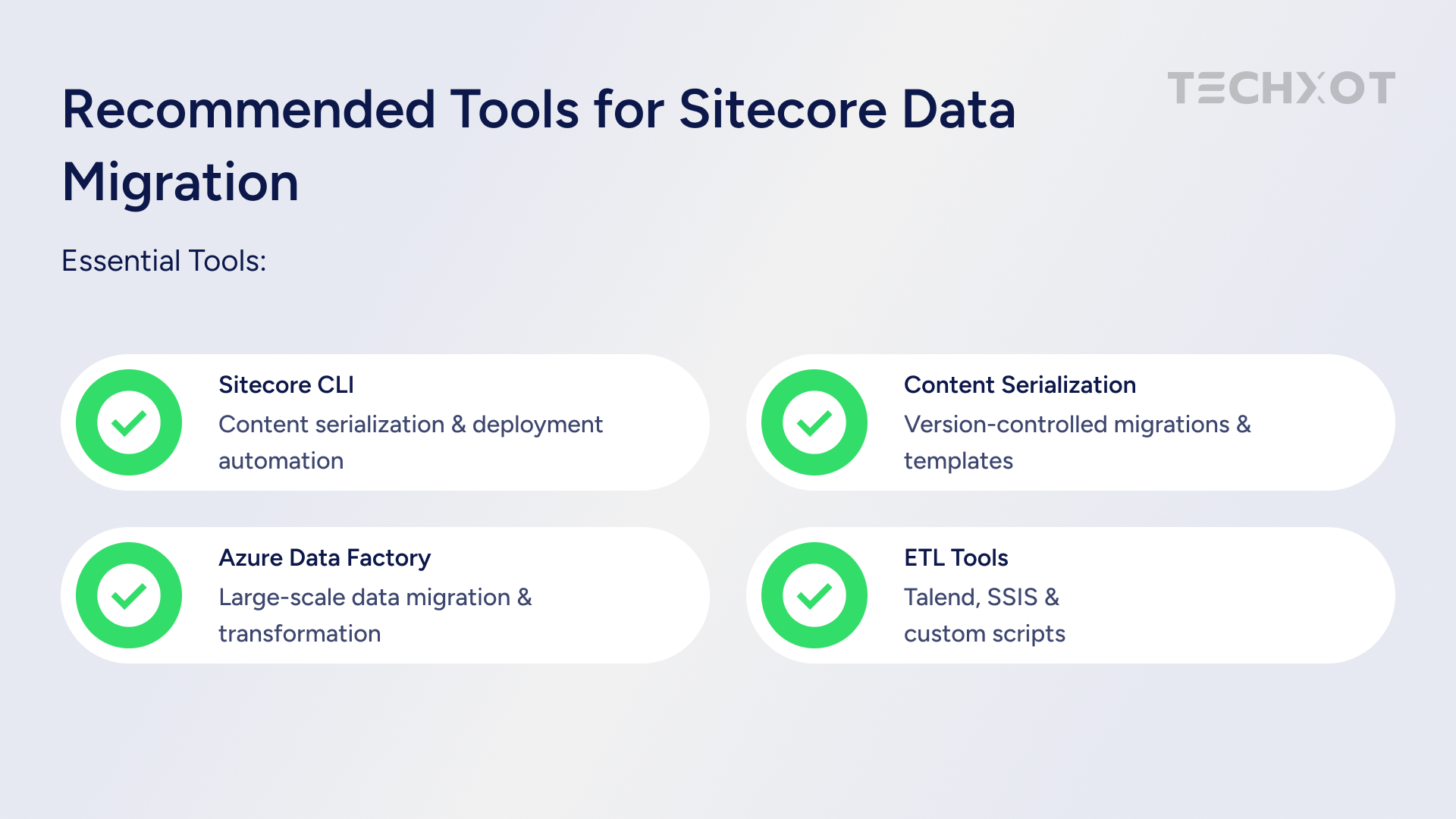
Recommended Tools for Migrating Data During Sitecore Implementation
Conclusion
Sitecore implementation challenges don’t come with platform; they come with execution of platform. Platform implementation failures happen from unclear goals, poor stakeholder alignment, weak migration planning, inadequate training, wrong architecture choice, and choosing the wrong implementation partner.
In order to reduce Sitecore implementation risks and enterprise team must keep in mind the following things:
Defining measurable business outcomes
Stakeholder involvement at earliest
User experience on priority
Choose scalable architecture
Deploy migration strategies
Train teams for easy adoption
Choose experienced Sitecore implementation partner
We at Techxot, help brands unlock platform capabilities for a digital experience that is scalable and relevant to the user. Techxot being the Sitecore silver partner, believes that the Sitecore implementation is not just a CMS deployment project, rather it’s a strategic investment for long-term digital growth platforms.