

Introduction
Composable and API first architectures are the very first preferences of the new age enterprises. Traditional CMS platforms have a reversed demand due to lack of modern features like omnichannel delivery, personalization, and performance scaling.
The modern Umbraco headless CMS decouples the presentation layer from the content layer which are frontend and backend layers respectively, thus offering developers to build flexible, scalable, and future ready digital experiences.
This decoupling enables enterprises to deliver content across multiple channels like websites, mobile apps, IoT devices, and digital kiosks. This shift is not just backed by technology; it’s backed by speed, scalability, and future readiness of the enterprise brands. This enables marketing teams to operate independently between both frontend and backend, reducing unnecessary bottlenecks and adding speed to time to market trends.
Core Principles of Umbraco Headless Content Architectures
To understand what brings traction to headless Umbraco architectures, it is important we take a look at principles driving it.
Decoupled Architecture:
As the frontend and backend work separately, developers have a freedom to create user interfaces with any framework while content is taken care of separately.API first approach:
All the content is delivered by APIs like REST OR GraphQL, making content delivery seamless to multiple channels.Content as a Service:
Content components are structured to be reusable and are not tied to a specific page layout. This encourages consistency across a variety of channels.Multi-channel Delivery:
The content delivery is seamless and can help websites, apps, mobile devices and many more get content delivery without duplication.Composable Architecture:
The architecture integrates with CRMs, CDPs and other analytical platforms for seamless digital experience delivery.
When an enterprise brand creates content in very large volumes for multiple regions and multiple platforms, the Umbraco headless architecture ensures to deliver efficiency, consistency and scalability.
Key Features of An Umbraco Headless CMS Platform
Umbraco Heartcore is a new age Umbraco headless CMS platform with various features tailored to enterprise needs.
APIs And Content Delivery:
The architectures provide separate APIs for content management and content delivery; this improves flexibility and control over content delivery models by the teams.Content Modeling:
Developers of enterprise brands can ensure reusability and consistency of content components by defining structured content types that align with their respective content requirements.Web hooks:
Teams use web hooks for real-time updates that trigger automated workflows and any frontend updates whenever content is changed.Built-in Caching:
The in-built caching improves performance by reducing API response time.Multi-language Support:
When an enterprise brand operates in multiple regions requires content delivery in multiple languages, thus the headless Umbraco support multilingual localized content delivery for global enterprises.Cloud- Native Architecture:
The headless architectures support cloud native infrastructures to build scalable, reliable and high-performance digital experiences.
Headless Umbraco architecture is a choice of global enterprises that centralize their content using headless, so same content is delivered to their websites, apps, and other platforms to ensure consistency and avoid risk of duplication.
Recommended Frontend Framework for Umbraco Headless Integration
As the new technology trends set new standards for the CMS, the headless Umbraco still wins over one advantage that is freedom to choose any frontend technology.
1. React (Next.js)
This is one of the preferred choices which offers server-side rendering static improved performance and search engine optimization.
2. Vue (Next.js)
This provides a flexible foundation which has a developer friendly framework to build scalable frontend that supports content delivery and APIs.
3. Angular
This is an enterprise grade framework used in cases of large scale headless Umbraco applications for long-term maintainability.
4. SvelteKit
This is a high-performance framework with JavaScript, for faster loading digital experiences.
Steps to integrate data from Umbraco to Next. JS:
1.Environment Variables

2. Reusable Fetch Utility
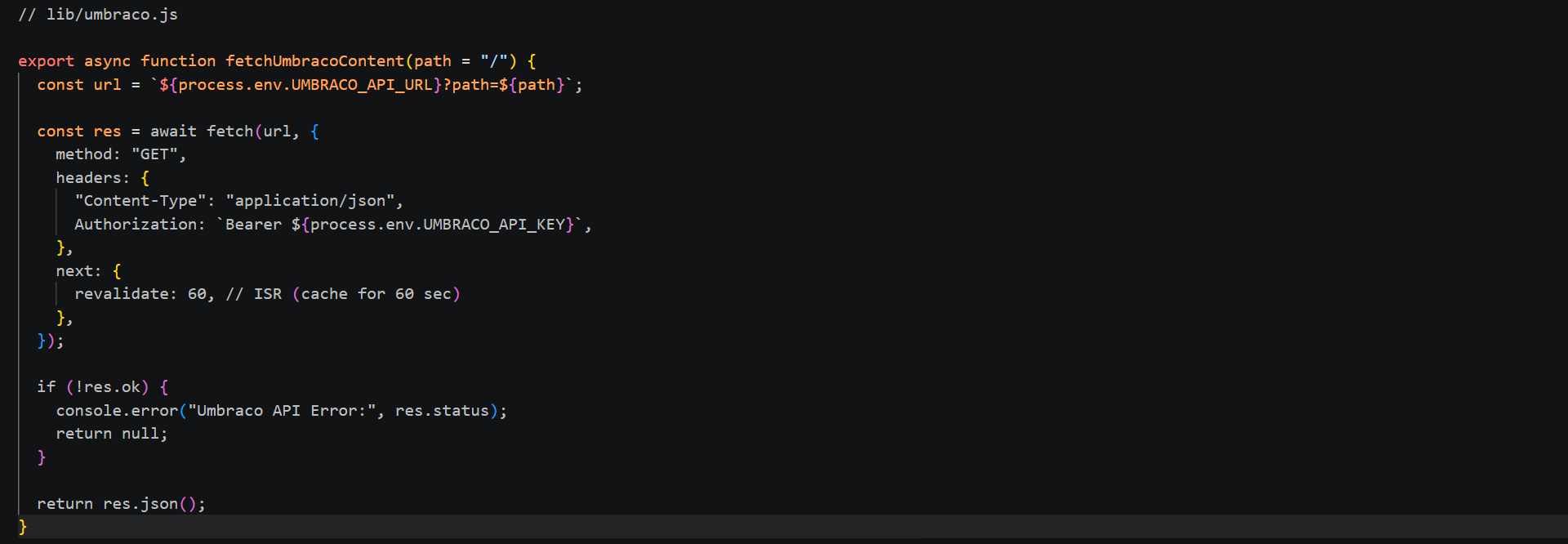
3. Use Dynamic Route (app/[…slug]/page.js)
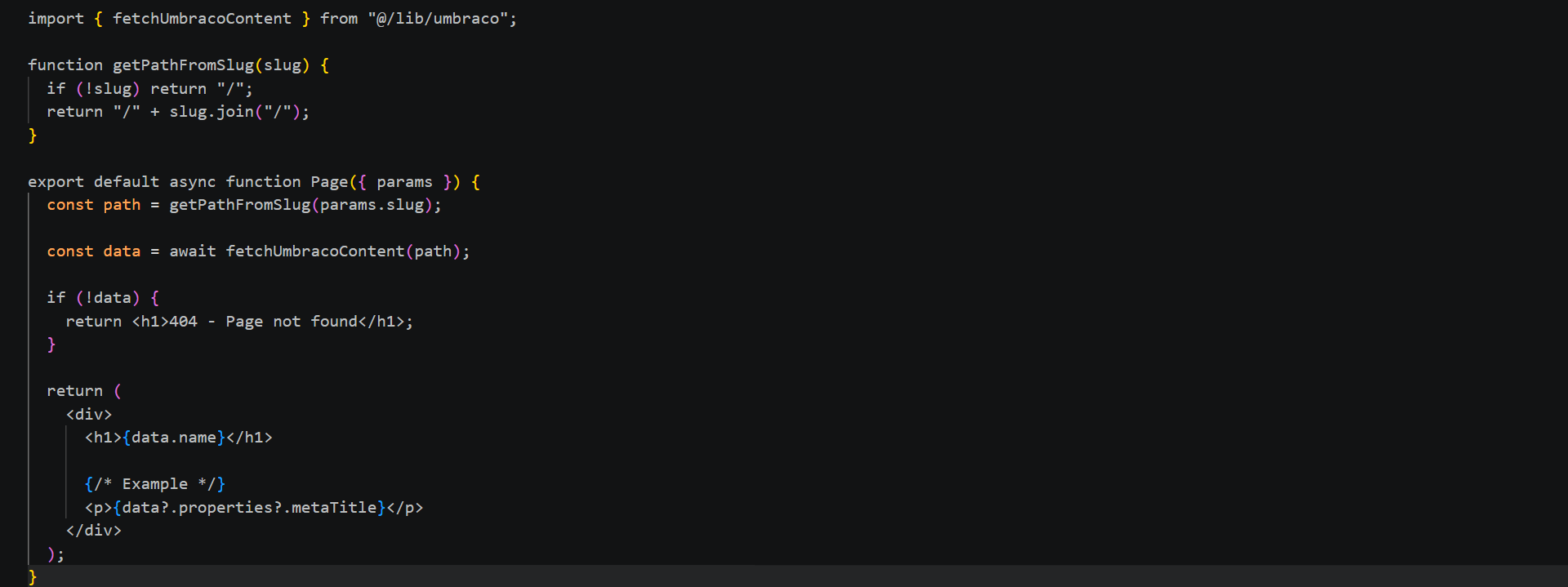
4. Homepage (app/page.js)

5. Secure API Proxy
Instead of exposing Umbraco API directly:

How To Integrate a JavaScript Frontend with Umbraco Headless CMS
The frontend JavaScript integration with Umbraco is seamless due to API-first structure.
Step by step integration:
1. Defining Content Models:
Defining content types for headless Umbraco to ensure that content remains consistent and reusable for all digital channel
2. Creating and Publishing Content:
Add content to the CMS to manage and deliver after it is published using APIs.
3. Access Content With API:
Use content delivery APIs of Umbraco to access content that is structured and from external APIs.
4. Fetch Data:
Connecting the JavaScript frontend to the APIs with HTTPS to retrieve and handle dynamic content.
5. Rendering Content in UI/UX:
To display user friendly interfaces for all channels, fetch and map data to frontend components.
This type of integration model allows enterprise to experience rapid development and seamless content delivery without redeploying the front-end.
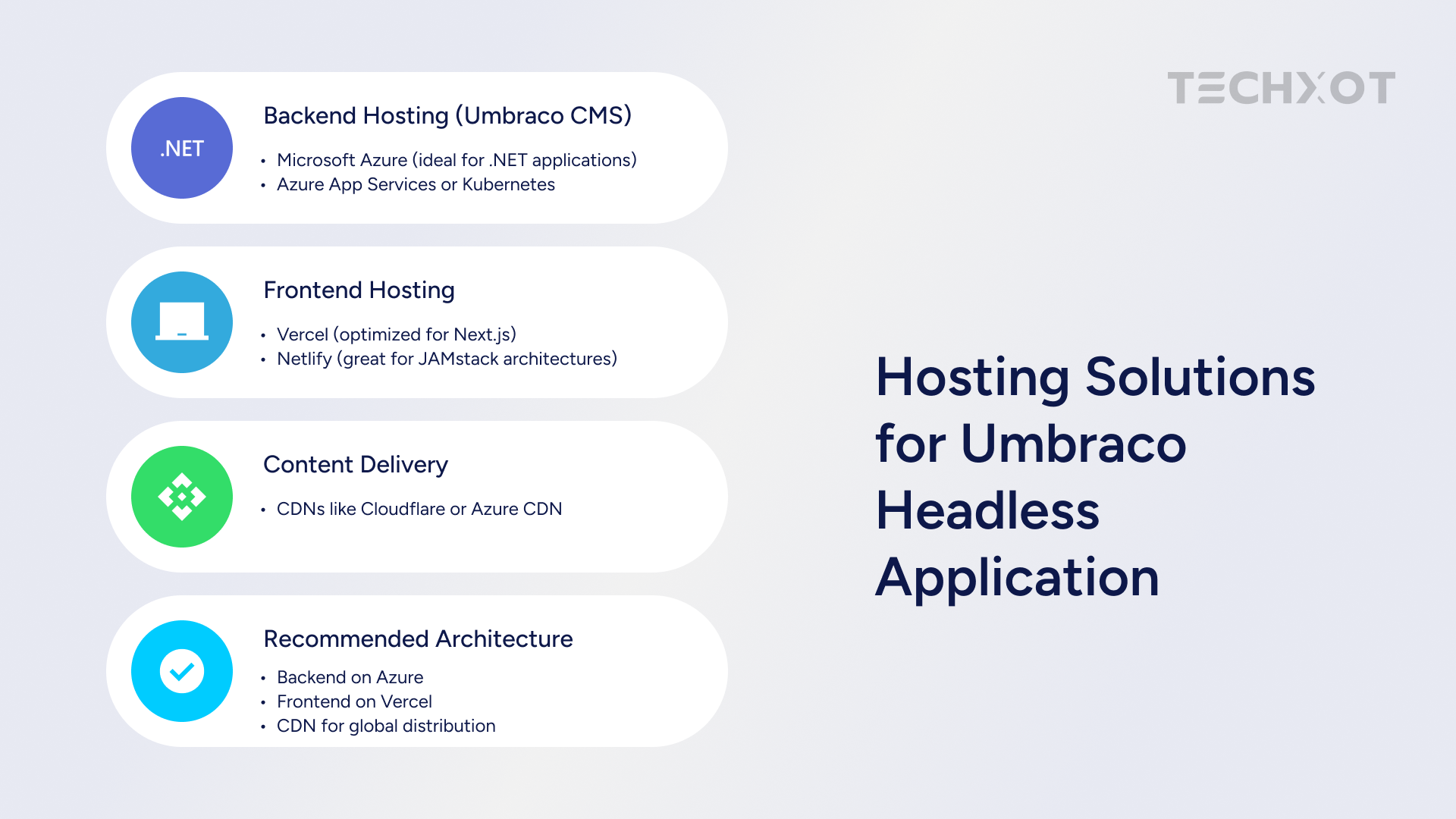
Hosting Solutions for Umbraco Headless Application
Performance, Scalability and Security Benefits of Umbraco Headless
Performance:
The headless Umbraco architecture CMS improves page loading time and elevates user experience with CDN based delivery and static rendering options.Scalability:
The decoupling of frontend and backend scale independently enables enterprise marketing teams to handle traffic spikes efficiently every time.Security:
The headless architectures are more secure because the decoupled systems reduce the surface prone to attacks. This allows APIs to be secured with authentication mechanism as CMS is also not directly exposed to users.
For all the global enterprises dealing with high traffic and sensitive data, Umbraco headless architecture always provides robust secure foundations.
Challenges Of Adopting Umbraco Headless
While Umbraco offers advantages like frontend flexibility, omnichannel content delivery, or API first architectures, it also comes with a set of challenges that enterprise teams can face.
Frontend dependency:
Implementing Umbraco headless requires a set of frontend developers with respective expertise since the presentation layer is built and maintained independently from the CMS.Initial setup complexity:
Setting up Umbraco headless requires planning architectures, APIs, and all integrations add up to initial development time compared to traditional CMS.Content preview limitations:
Previewing how content appears on all platforms can be challenging because previewing environments require extra configurations.Content Governance complexity:
Managing reusable content components of multiple channels becomes a challenge if the content models are not well defined.API dependency:
Content delivery solely depends on APIs to do the downfalls of APIs like latency, downtime or inefficiency will create an impact on performance and user experience.
Conclusion
The CMS industry has seen a significant shift towards composable, API-driven digital ecosystems. This has also increased the adoption of Umbraco headless enterprise requirements.
Umbraco is the future of enterprises because it enables them:
Omnichannel experience delivery
Scale efficiently
Innovate faster with new technologies
Headless Umbraco is built on a strong .NET foundation with flexible architecture, and enterprise use features, it is primarily the preferred choice of enterprises looking for future-proof digital experience journeys.
If you are an enterprise who wants to implement Umbraco headless with the right strategy and right partner like Techxot to accelerate digital experiences journey transformation to build digital ecosystems that scale in the long-term and perform better.
Get in touch with a certified Umbraco partner now! Get in touch with Techxot!