
The Future of Digital Experience Platforms
In the new era of digital experience, customer expectations are at a significant rise; the digital experience platforms are rising beyond monolithic suites. The AI-first and composable systems enable enterprise brands to deliver seamless and personalized digital engagement at a scale. This platform transformation is not just technical but strategic.
What are Digital Experience Platforms?
The best Digital Experience Platforms are integrated technologies that enable enterprise teams to create, manage, optimize, and deliver digital experiences across all customer touch points like web, voice interface, mobile apps, and much more.
Traditional DXPs offer all under one roof; content management, customer data, analytics and personalization. All these components were tightly coupled and created complexity and limitations like;
Longer deployment cycles
Vendor lock-in
Limited flexibility
Innovation bottlenecks
This is why the composable and AI–first DXP architectures changed the digital experience ecosystem.
Why “AI-first” Matters?
AI has reshaped the digital experiences are powered by:
Predictive personalization
Automated content generation
Real-time optimization
Customer intent prediction
Intelligent automation campaigns
In the new age digital experience ecosystems, the customers expect the brands to deliver personalized experiences and deny irrelevant experiences. AI enables digital systems to transform the raw data into contextual insightful data. They allow behavioral signals to turn into real-time personalization, engagement metrics into content optimization, and predictive model into next-best-action recommendations. This has significantly proved that AI capabilities are no longer just add-ons but a foundation of new digital experience ecosystems.
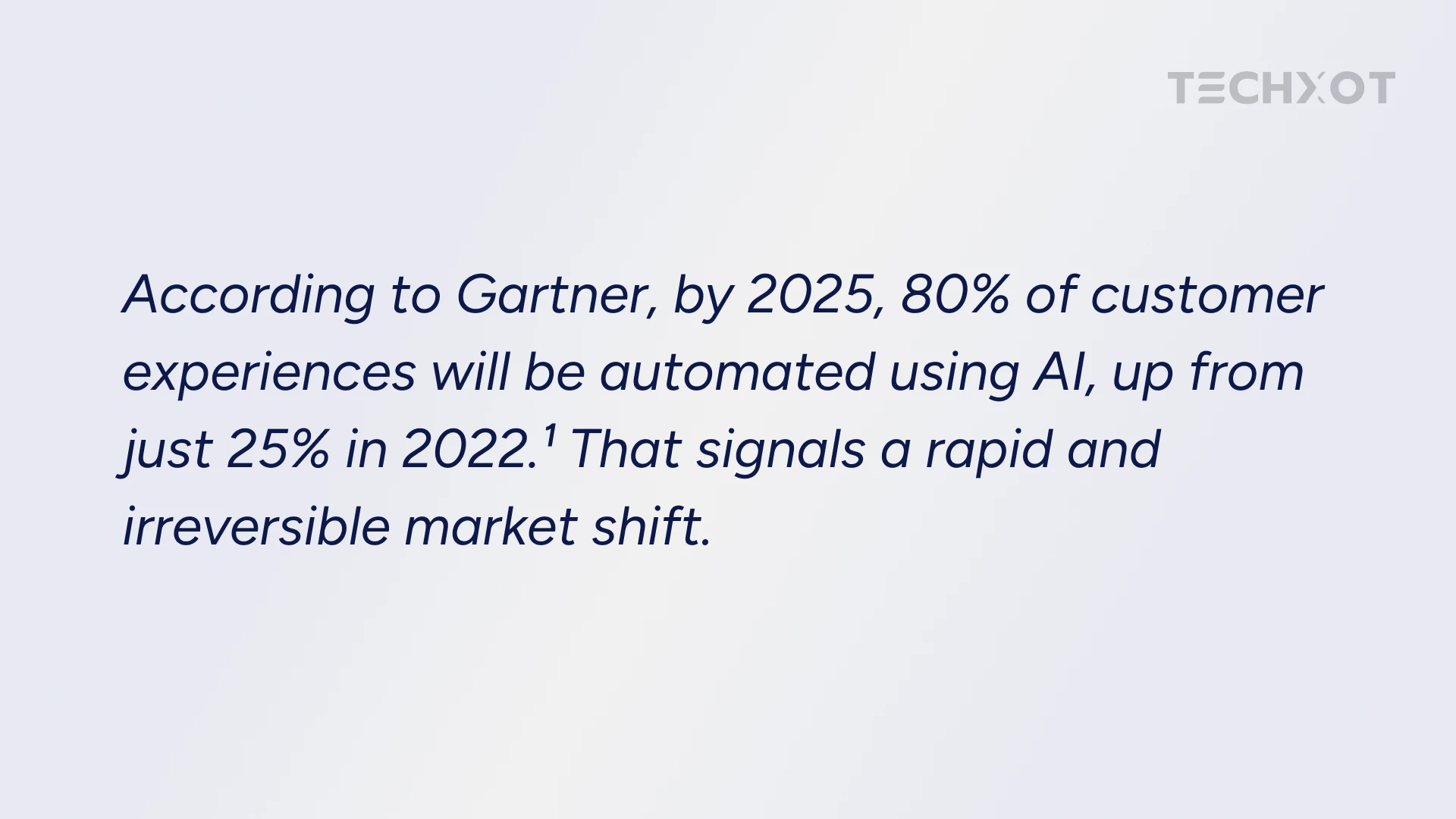
Shift To Composable Architectures
Composable DXPs are a new age approach to digital experience platforms where experience capabilities that are built with modular, API-first, flexible, scalable with interchangeable components instead of an all-in-one system.
Composable DXPs help enterprises to launch experience faster, avoid vendor lock-ins, innovate continuously, and deliver consistent omnichannel journeys.
Key Principles of Composable Digital Experience Platforms
Principles | Outcomes |
API-first | Seamless integration with best services |
Modular components | Flexibility to avoid custom solution |
Headless delivery | Decoupled front-end for omnichannel reach |
Cloud Native | Lower operational costs |
Event Driven | Real-time responsiveness |
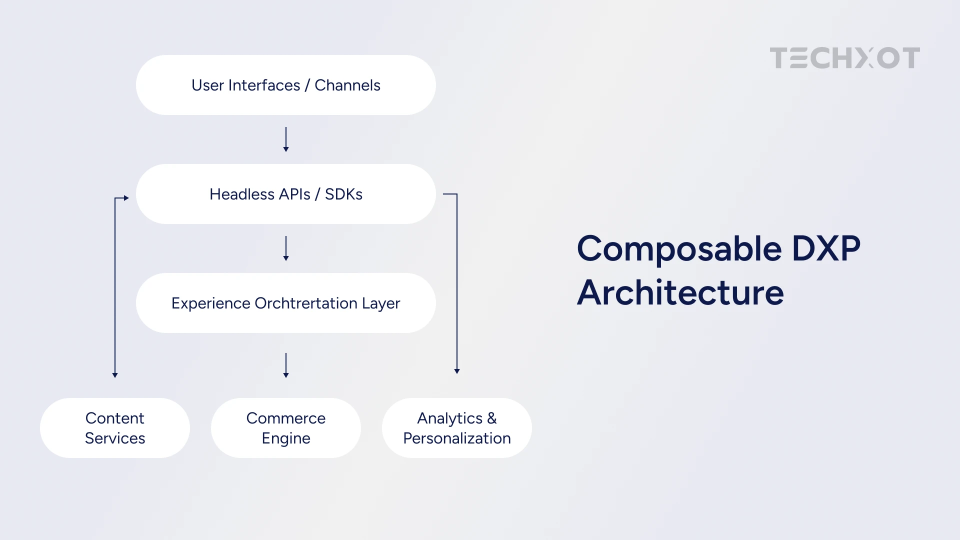
AI Capabilities and Composable Architectures
AI capabilities and composable architectures have delivered advantages by creating a powerful foundation for next-gen digital experiences. AI and composable is a winning combination where AI bring automation and predictive decision making and composability brings flexibility to deploy these capabilities across best digital experience platforms. Together they help enterprises to innovate, personalize, scale, and adapt instantly to continuously changing customer needs.
When AI and composable come together, digital experiences become:
Real-time and personalized:
AI used user behavior data from different sources like CRM, analytics, sales, and support to deliver one unified view of the user.Scalable:
Enterprise teams hold zero dependency on the central vendor for any updates, tests, and launching new digital experiences.
Future-ready:
As the world moves ahead with newer technological advancements, the composable DXP has proved to be more reliable by adapting it without replacing the whole stack.
Optimized by automation:
AI automation capabilities automate repetitive tasks like content tagging and journey orchestration and free up the teams to focus more on creating new strategies.
Industry Momentum: Where Is Digital Experience Platform Market Heading?
This new age AI and composable digital experience platform is not just a trend that will pass; it is rather a new era of industry transformations. It is the architecture that is prioritizing automation, intelligence, flexibility, and speed. This transformation has broadly unified all the market leaders, technology vendors, and enterprises to align together with this architecture. The customers now demand relevant digital experiences; hence the enterprise brands are now investing heavily in modern DXP strategies that bring measurable outcomes.
Here are some of the factors that are pushing enterprises towards AI-first and composable DXPs
Variable Touchpoints
There is an increase in the number of customer touchpoints, talk about websites, kiosks, apps, voice assistance, wearables, and much more. Every touchpoint demands unique customization and personalization while staying on a brand.
Adoption Of Headless CMS
The headless content management systems are no longer a niche, rather becoming the staple of modern digital platforms.
Demand For Real-time Experiences
The new age customers demand relevance at every instance, static interactions no longer suffice
Compliance And Data Privacy
Compliance is easy in composable architecture as they allow enterprises to isolate and control how the data flows.
Competitive Edge
Enterprise brands that fail to deliver intelligent personalized digital experience that are potentially at risk of losing customers to an enterprise brand that delivers personalized experiences.
Use Cases Of AI-first and Composable Architecture
Retail
Customers can experience personalized shopping journeys; AI predicts product interests through behavioral insights and provides real-time personalized recommendations across digital journeys. While composable, bring in the best commerce engines.
Financial Services
AI enabled chatbots are used to resolve common queries, on the other hand composable API integrates the transaction data, loyalty systems and messaging platforms.
Healthcare
Personalized care reminders and tailored content can be achieved with AI and composable DXPs as they unify patient records, appointment systems, and health content at one place.
Travel
AI uses behavioral insights to understand booking behavior and seasonal demand while composable systems update dynamic offer instantly across all user touchpoints.
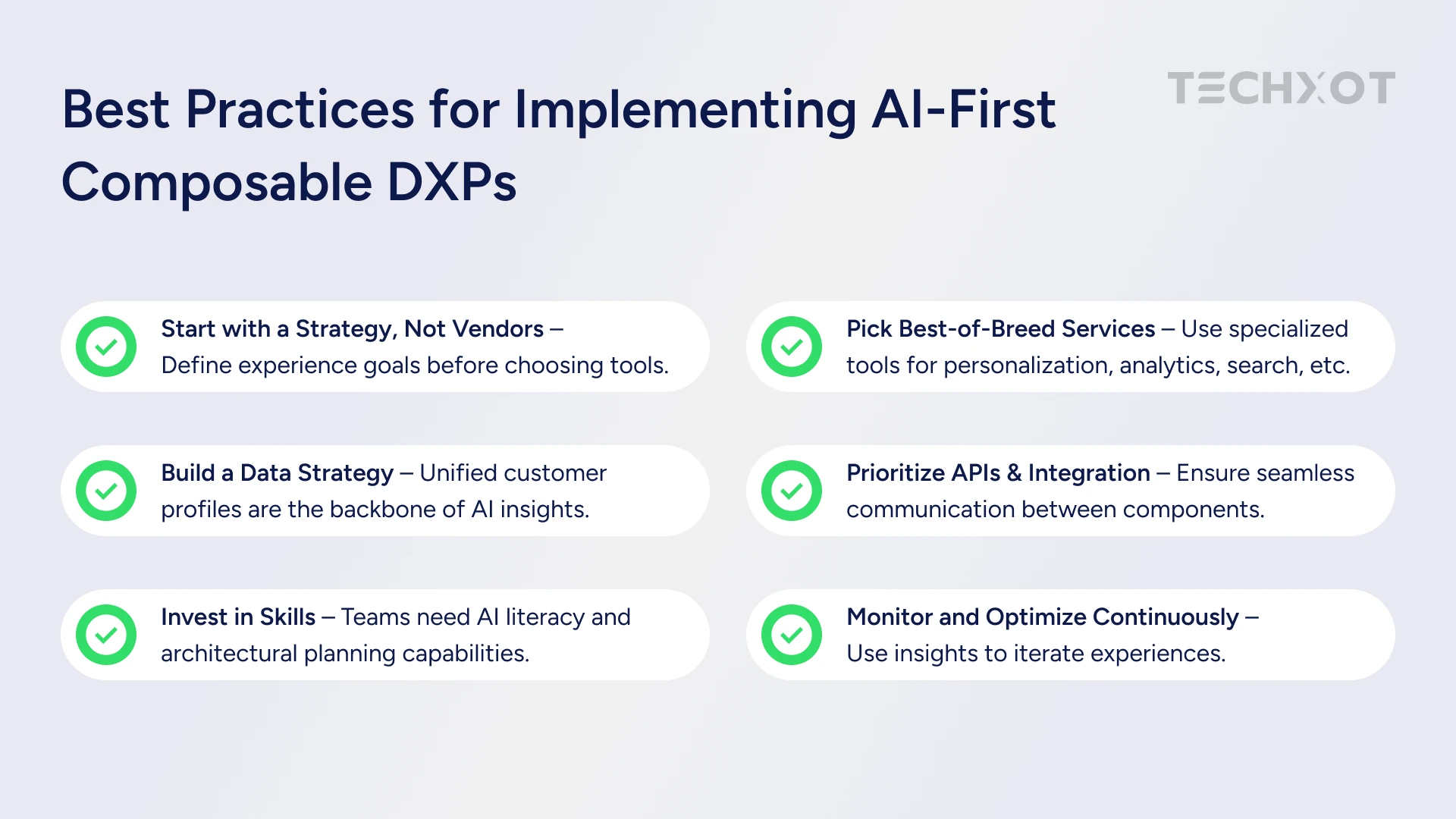
Challenges to Navigate in This Transformation with Best Digital Experience Platforms
Although AI-first and composable architectures have proven to be significantly an advantage. AI brings automation, intelligence, and predictive decision-making models while composability brings flexibility to integrate these AI capabilities seamlessly adapting to new technological enhancements too. Together they create a powerful foundation for next-gen enterprise brands to innovate faster, personalize, scale, and adapt to continuous changing customer needs.
This transition from monolithic suites to AI-first and composable DXPs might be promising but comes with its set of obstacles.
Data Silos: When the user data is fragmented, AI cannot personalize accurately.
Skill bags: Teams can lack expertise required in AI model.
Vendor Lock-in Fear: Enterprise brands may struggle with migrating from legacy systems.
Governance: Composable systems demand reliable and strong governance to manage multiple integrations and vendors.
Conclusion
The next decade of digital experience innovation is set to be intelligent, adaptive, and flexible. Enterprise brands that work together with AI-first and composable architectures are defined to outpace all competitors not adapting to this trend. At Techxot, we believe in 2026 and beyond, best digital experience platforms will deliver exceptional experiences and innovate faster. The golden rule is that customer expectation evolves and does digital experience platforms evolve.
We at Techxot, design intelligent, composable experience architectures and strategies that are scalable, high-performing, and revenue driven digital ecosystems.