
Introduction
In 2026, digital experience platforms (DXP) don’t fail because of the technology; they fail very early, at the stage of choosing DXP partner. Enterprises choose their DXP implementation partner based on brand reputation, pricing and certification thinking the platform will do the required delivery. Although all these three parameters are vital in choosing a DXP partner, they serve only surface-level evaluation that doesn’t guarantee optimization and performance of the platform
Choosing a right partner for your business outcomes, it is important to understand that DXP implementation partner selection is not a procurement process rather a strategic decision that decides how the DXPs right implementation, adoption, scaling and growth can be achieved.
Redefining the Role of DXP Implementation Partner
There are enterprises that think a DXP implementation partner is here to configure features, deliver a go-live, and leave. This type of transactional approach is one of the most common reasons DXP partners get hired and the reason why digital experience platforms (DXP) underperform. Every DXP to succeed requires strategy, architecture, and execution. When choosing an implementation partner, one must remember a DXP partner is someone who plays a broader role and continuously focuses on aligning enterprise business goals with platform capabilities, designing architecture, enabling internal teams and guiding long-term transformation. On the contrary, when you choose a vendor, he is focused just to meet the delivery timelines, and fails to align outcomes like adoption, performance, and growth.
The distinction matters when choosing a DXP partner, because it is important to understand that DXPs are not a one-time project rather long-term enterprise platform and choosing right partner will decide how DXPs take shape and what value they deliver over time.
What Most Enterprises Miss Before Evaluating DXP Partners
In most enterprises, the decision to choose a DXP partner begins after the DXP is chosen, and RFPs are issued. Isn’t this the biggest red flag to start your DXP transformation journey?
At Techxot as a DXP implementation partner, we understand that your decisions at these points are influenced by certifications, demos, documentation, and price points.
Do we agree with you about this totally? No, not completely.
Because these factors don’t have a big impact on how better a partner will perform to deliver in the real world. Rather delivery discipline, collaboration patterns, architectural thinking and mindset are the vital impact contributing factors that get dismissed because it can be hard to assess them at early stages. And when this decision goes wrong, it can result in relay of delays, reworks, and misaligned business outcomes.
So, to help you in choosing DXP partner that fits just right for all your requirements you need to consider the following:
Who to choose: Platform specialist vs Platform generalist?
DXP partners who are platform specialists bring certifications, recognition, knowledge, scale, growth, governance, implementation and integration experiences. On the other hand, generalists are someone who may be certified but lack enterprise-level experience which may result in poor strategy, architecture thinking and collaborative style that compromises execution quality to an extent where the DXPs can fail post go-live.Collaboration Model & Cultural Alignment in Long-running Enterprise Programs
DXP implementation is a collaboration between external partners and internal teams of marketing & IT. The partner teams align with your communication style, adaptability and working culture to deliver speed, governance and stakeholder trust to easy decision-making and reduce execution friction through the implementation of DXPs.Operating In a Multi-vendor, Multi-stakeholder DXP Ecosystem
Digital experience platform implementation and execution is a collective collaboration of multiple multi-level vendors like: UX design teams, CRM vendors, analytics teams, and internal teams of stakeholders. Partners that fail to operate territorially create unnecessary delivery delays and operational risks.Attention to Detail, Quality Discipline, and Delivery Craftsmanship
Every enterprise DXP stands by strong governance, quality delivery, and implementation discipline. So, execution shortcuts and workflow gaps often result in major performance challenges. Choosing the right DXP implementation partner for your enterprise is important because they deliver governance, consistency, stability, adoption, and long-term platform sustainability.
Architecture-Led Engineering vs Code-First Execution
Your DXP must evolve with enterprise business needs. When the DXP implementor has an architecture-led mindset, they create solutions that are specific for scalability, maintainability, and easy future upgrades. While the partner that is code-first mindset creates technical debt but runs faster towards the launch timelines.
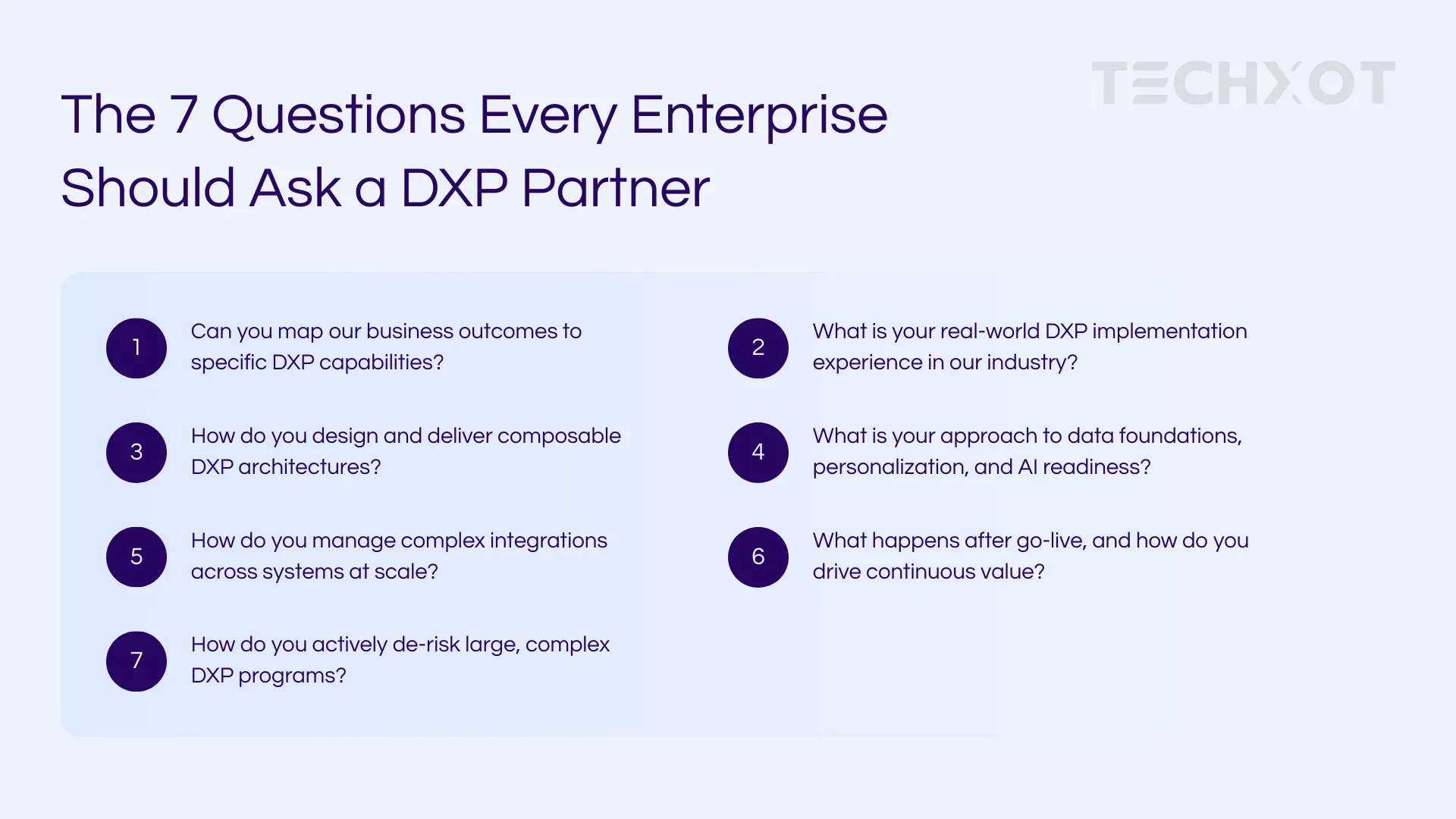
The 7 Questions Every Enterprise Should Ask a DXP Partner
How To Evaluate the Answers to The Questions to The DXP Partner:
1. Can You Map Our Business Outcomes to Specific DXP Capabilities?
When you ask this question, an ideal DXP partner will talk about business outcomes like platform growth, ROI, customer experience, operational efficiency, and take you faster –to-market using DXP capabilities to support business outcomes stated. The answer should talk about the value of post implementation and not what features the DXP supports.
2. What is your real-world DXP implementation experience in our industry?
An experienced DXP implementation partner with real world industry experience focuses on spending time to make you understand scale, complexity, operational structures, customer behavior, and compliance. They should mention challenges faced, how they were addressed, and what lessons they learnt from similar implementations.
3. How Do You Design and Deliver Composable DXP Architectures?
When talking to a composable DXP architecture executer, it is important that he talks about modularity and governance. This includes understanding integration patterns, principles of API, and lifecycle management along with demonstrating how composable DXP architectures are flexible without complexity and operational risks.
4. What Is Your Approach to Data Foundations, Personalization, And AI Readiness?
A DXP implementation partner understands how the data is collected and governed to discuss an approach for personalization which requires authentic data foundations. The partner uses these data use cases to finally scale the DXP towards AI enhancements.
5. How Do You Manage Complex Integrations Across Systems at Scale?
When talking about DXP integrations, it is important for the partners to discuss accountability for performance, compliance, resilience, and long-term platform maintainability. The partner should possess deep knowledge about the dependencies of CRM, ERP, CDP, PIM, analytics, DXP, and how they minimize any operational overheads.
6.What happens after go-live, and how do you drive continuous value?
When you hire a reliable DXP partner, they don’t just be there till you go live, but stay behind post-launch to support, optimize, experiment and improve post-launch DXP model. They don’t end their project after going live, rather talk about how they improve engagement after going-live to optimize the success metrics, maintenance cycles, and roadmaps.
7. How Do You Actively De-Risk Large, Complex DXP Programs?
They proactively demonstrate how they identify your organizational, technical, and dependency risk. They should help you guide through risk management discussions where they talk about the scope of work, timelines, program outcome alignment, and deliverable to keep the DXP program from failing.
Conclusion
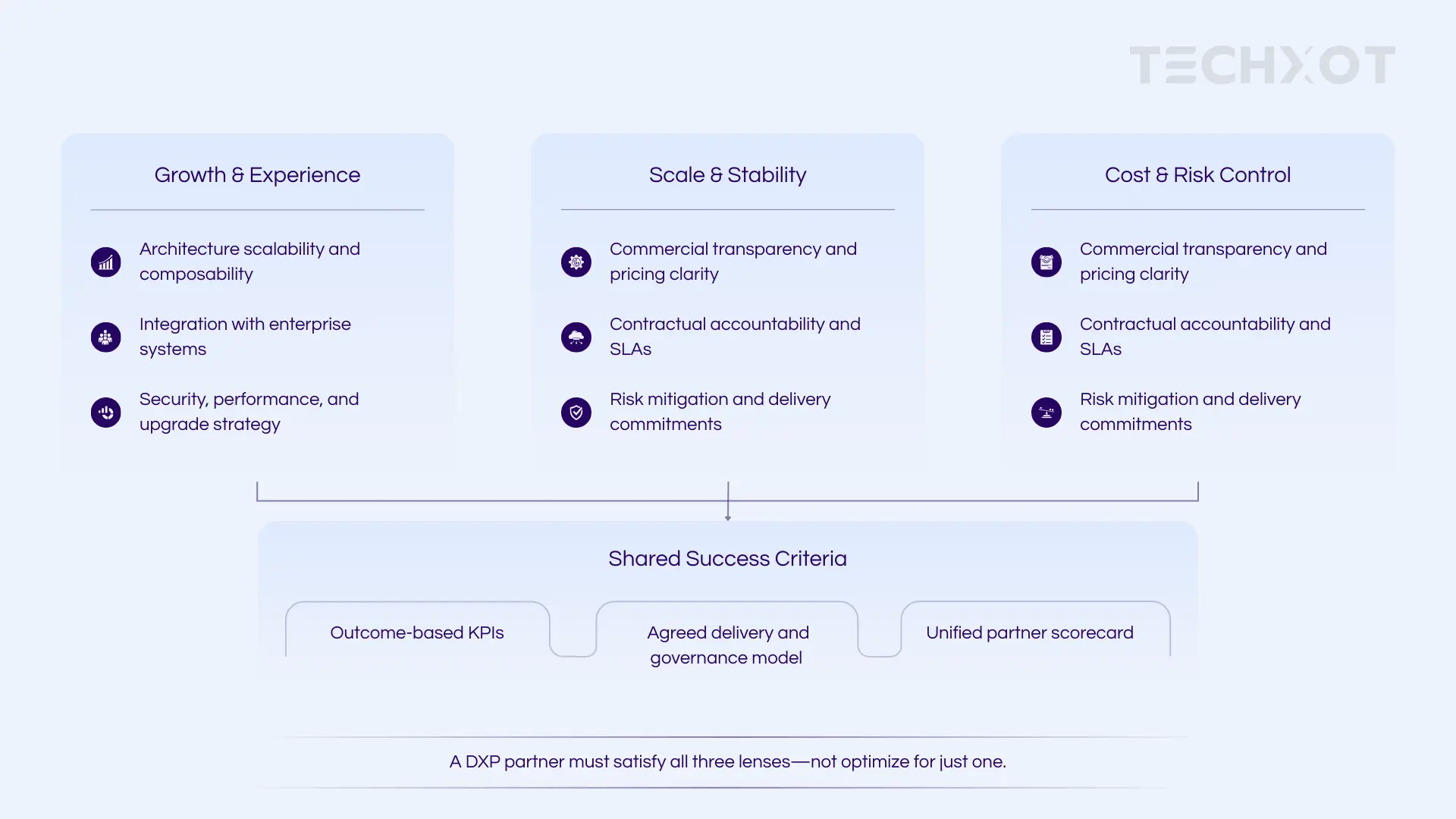
The DXP platforms have evolved over the years and enterprises that have succeeded understand that choosing DXP partner is not just any other procurement process but a complete digital transformation journey. Choosing the wrong partner can have compounding consequences for years and eventually the DXP will fail. Choosing the right partner isn’t always justified in numbers; it can be justified by architecture’s mindset, delivery discipline, and accountability. When an enterprise approaches partner selection with understanding, clarity and cross functional alignment, they sign up for a low-risk transformation. The right partner will always align business outcomes, technical realities and implementation to turn the DXP platform into a scalable, long-term capability to drive value.
We help enterprises evaluate better, read red flags early, and align stakeholder expectations.
Take your first step towards digital experience platform consulting with Techxot. Contact us today.