
1. Introduction
An Umbraco website that has great content, can still face difficulty generating organic visibility. Many websites suffer due to poorly implemented page structures, search signals, or technical foundations.
Umbraco SEO is more than just adding keywords to pages; it is making crawling easy for search engines, making websites easy for users to understand, and optimized for AI-powered search systems to retrieve and interpret.
Techxot has successfully delivered more than 12+ Umbraco SEO projects. With more than 10+ Umbraco SEO Specialist on board Techxot has achieved Official Umbraco Silver Partner badges which demonstrates 10+ years of experience.
2. What is Umbraco SEO?
Umbraco SEO is the process of optimization Umbraco websites so they are easily discoverable by search engines and AI-powered search engines. These systems crawl, index and surfaces content, combines technical SEO, page optimization, search-intent-driven content strategy, performance, AEO, GEO, internal links and monitoring together.
For Umbraco website users, the strongest approach combines technical SEO, search-intent driving content, structured data, website performance, and platform etc.
3. What Makes an Umbraco Website SEO-friendly?
Umbraco provides multiple elements that influence how an enterprise website is discovered and understood by users. At Techxot, in our Umbraco projects, we treat SEO as an important architectural implementation partner and something we do post development.
An Umbraco implementation that is search-ready should provide:
SEO titles and meta description
Clean, descriptive URLs
Heading hierarchy
Canonical URLs
XML sitemaps
Robots.txt
301 redirects
Internal linking
Image metadata
Structured data
Multilingual content
Site-specific metadata for multisite implementations
These CMS platform capabilities alone don’t contribute to search visibility. The real SEO generates results when these capabilities are strategically implemented across the website.
For example, every Umbraco service page should have SEO optimized title, meta data, meta description, one H1 heading, internal links, schema, images and content all these must be relevant to the users search intent.
4. How Do You Build Technical SEO Foundation For An Umbraco Website?
Content optimization is a crucial step for SEO. But before that it is important to make sure search engines efficiently crawl and index the website.
Website pages should have necessary access by the search engines for crawling and Indexing.
SEO experts must strongly review:
Robot.txt
Meta robots directives
XML sitemaps
Canonical tags
Redirects
404 pages
Duplicate URLs
Parameter-based URLs
Orphan pages
Blocking a URL doesn’t eliminate the search results. Indexing a website is an important step which needs to be managed using technical mechanisms for every situation. Many times, developers treat robot.txt as a general tool that is a solution for every SEO problem.
URL Structure
URLs must be short, descriptive and communicate with right page meaning.
Example:
/ services/umbraco-development/  is easy to understand than:

/page?id=926380
lways keep the URLs consistent. If URLs are changed, implement a relevant 301 redirect. Verify all internal links and point to new destinations.
Canonicalization
Canonical tags help search engines identify preferred URL, if same or duplicate versions exist.
Developers need to understand that canonical tags are not a substitute fix for poor information architecture. Teams must address concerned technical issues for having multiple unnecessary URLs.
Example:
 Preferred URL: /services/umbraco-development/
 Redirect old URL: /umbraco-development-services/ → /services/umbraco-development/
 Canonical: /services/umbraco-development/
5. How To Optimize Umbraco Pages For Search Intent?
When the technical foundation is optimized, it is time for individual website pages to be aligned and optimized according to the user's intent.
All pages must have clear:
Primary topic
Search intent
SEO title
Meta description
H1
Supporting headings
Internal links
Relevant images
Call to action
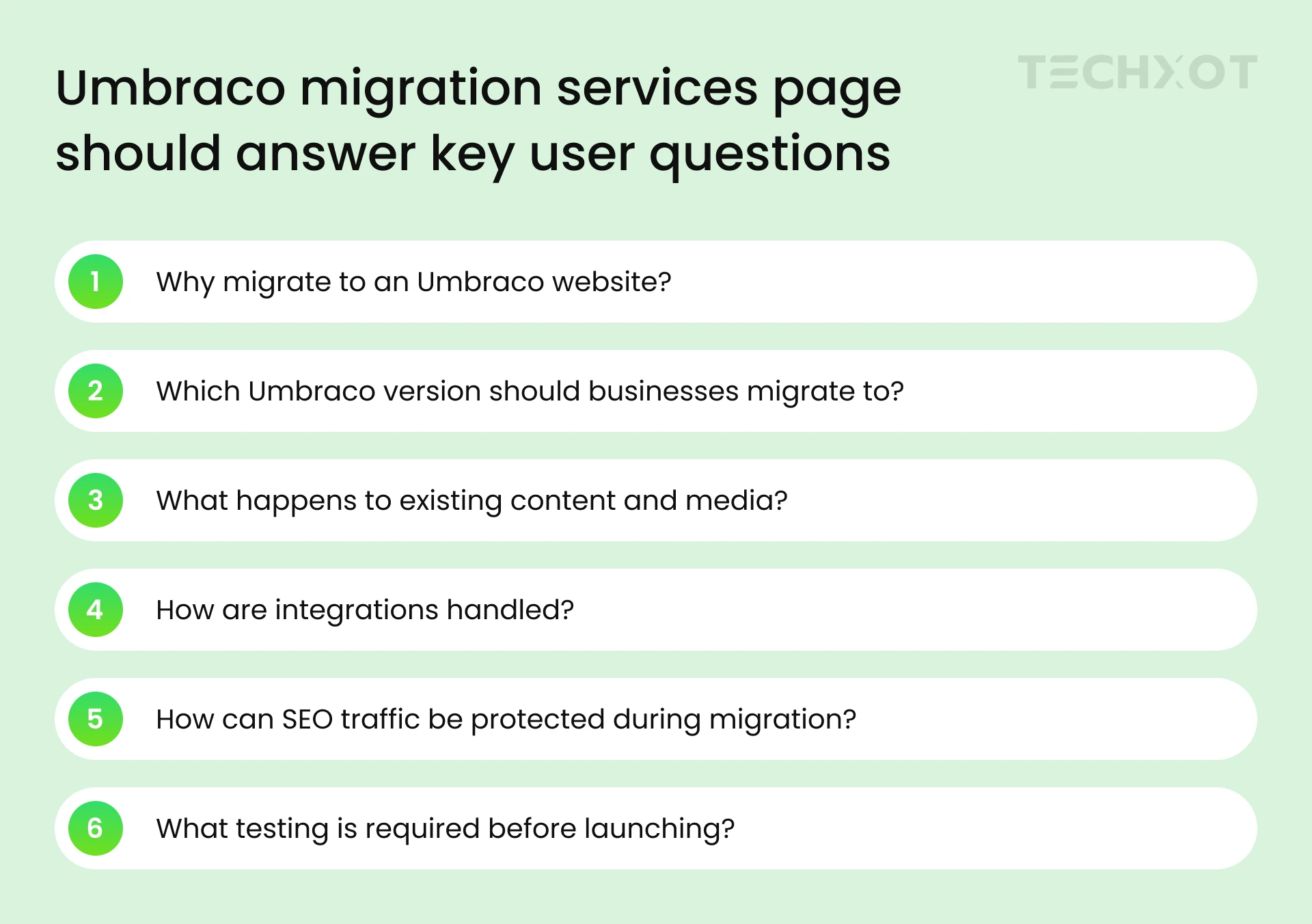
Example for SEO Setup
SEO title:
Umbraco migration services | Plan, build, migrate & optimize
Meta description:
Migrate your enterprise Umbraco website following strategic content migration, integrations, testing and post launch optimization
H1:
Umbraco migration services
URL:
/ services/umbraco-migration/ All these SEO components should reinforce the same topic without being repetitive.
6. How Do You Optimize Your Umbraco Websites For Answer Engines?
The answer engine optimization makes important information easy to identify and understand when users ask questions.
This step is crucial for all technical and commercial topics as they involve a lot of questions.
Avoid writing information that has long paragraphs, rather structure information clearly.
Example
“Does Umbraco support SEO?
Yes. Umbraco supports SEO-friendly websites through URLs, metadata, structured content, and integration flexibility.”
This answer-first approach helps users receive information they need and helps search engines and AI systems interpret this content.
The AI systems use the following to interpret information:
Clear question-based headings
Direct answers
Short explanatory paragraphs
Lists where appropriate
Definitions for technical terms
Supporting examples
Relevant internal links
7. How To Optimize Content For GEO?
Generative Engine Optimization is frequently talked about as businesses now see beyond traditional search results pages.
The practical objective of optimizing content for GEO is to make that content useful for those systems that retrieve information and generate answers.
Ways to strengthen GEO:
Entity clarity:
Clearly describe each entity in the content. Example, organizations, products, platforms, services, technologies etc.
For example:
Distinguishing properly between
Umbraco CMS
Umbraco Cloud
Umbraco Development
Umbraco Migration
And not treating “Umbraco” as one targeted keyword.
Answer completeness
Try answering all important questions that surround a topic and not just answer one keyword of variation.
Original information
Keep adding content that describes implementation guides, examples, technical explanation, practical experiences, and case studies when possible. This content creation credibility and trust for brands.
Consistency
Keep certain content components consistent throughout the website. Information like company information, service description, expertise, contact information, and important business profiles.
8. Strengthen E-E-A-T With Real Expertise
E-E-A-T refers to Experience, Expertise, Authority, and Trustworthiness. This is important for all those businesses to publish technical content.
Instead of writing generic topics like “Umbraco is flexible and scalable CMS”, write on topics about how this scalability affects the implementation decisions.
Demonstrate expertise through:
Author bios
Relevant professional experience
Original technical insights
Implementation examples
Case studies
First-hand lessons
Expert quotes
Documentation references
Transparent company information
Clear ownership of published content
It is important for enterprises to mention statistics, client results, certifications, or project experience that can be proven and perceived by authority.
9. What Structured Data Should Be Used To Clarify Content
Structured data sets up a machine-readable context for every page that helps provide additional information about that page. For a Techxot implemented Umbraco project we encourage development teams to build dynamic schema approach for building structured data.
Umbraco page type | Recommended structured data | Purpose |
|---|---|---|
Homepage | Organization / WebSite | Identify the organization and website |
Service page | Service | Service |
Blog article | Article | Identify article, author, publisher and dates |
Product page | Product | Describe a specific product and eligible product information |
Breadcrumb-enabled page | BreadcrumbList | Describe page hierarchy |
Local business location | LocalBusiness | Describe a physical business location where applicable |
FAQ content | FAQPage* | Describe qualifying FAQ content where applicable |
A schema communicates information like headlines, author bio, publishing date and publisher name. Umbraco architecture supports automated schema generation for structured content.
The schema should always represent the content that users can actually see on the page, and not because a schema type exists.
10. Monitor Performance
Search visibility and user experience are directly connected. An Umbraco website which has large images, insufficient scripts or unnecessary requests can deliver poor user experience.
At Techxot, we review the following to optimize the performance:
Core Web Vitals
Page speed
Image compression
Responsive images
Modern image formats
Lazy loading
Caching
CDN delivery
JavaScript rendering
Mobile responsiveness
Performance optimization is always associated with user experience more than an arbitrary score.
11. Making Multilingual Websites Search-Ready
When an enterprise has multilingual websites, translating content is not the only part of their SEO practices.
At Techxot, we evaluated every regional language for:
Localized URLs
Localized titles and descriptions
Search intent
Regional keyword research
hreflang
Canonical relationships
Internal linking
Country-specific content
The international SEO should be a combination of translation, localization, technical implementation, and regional search.
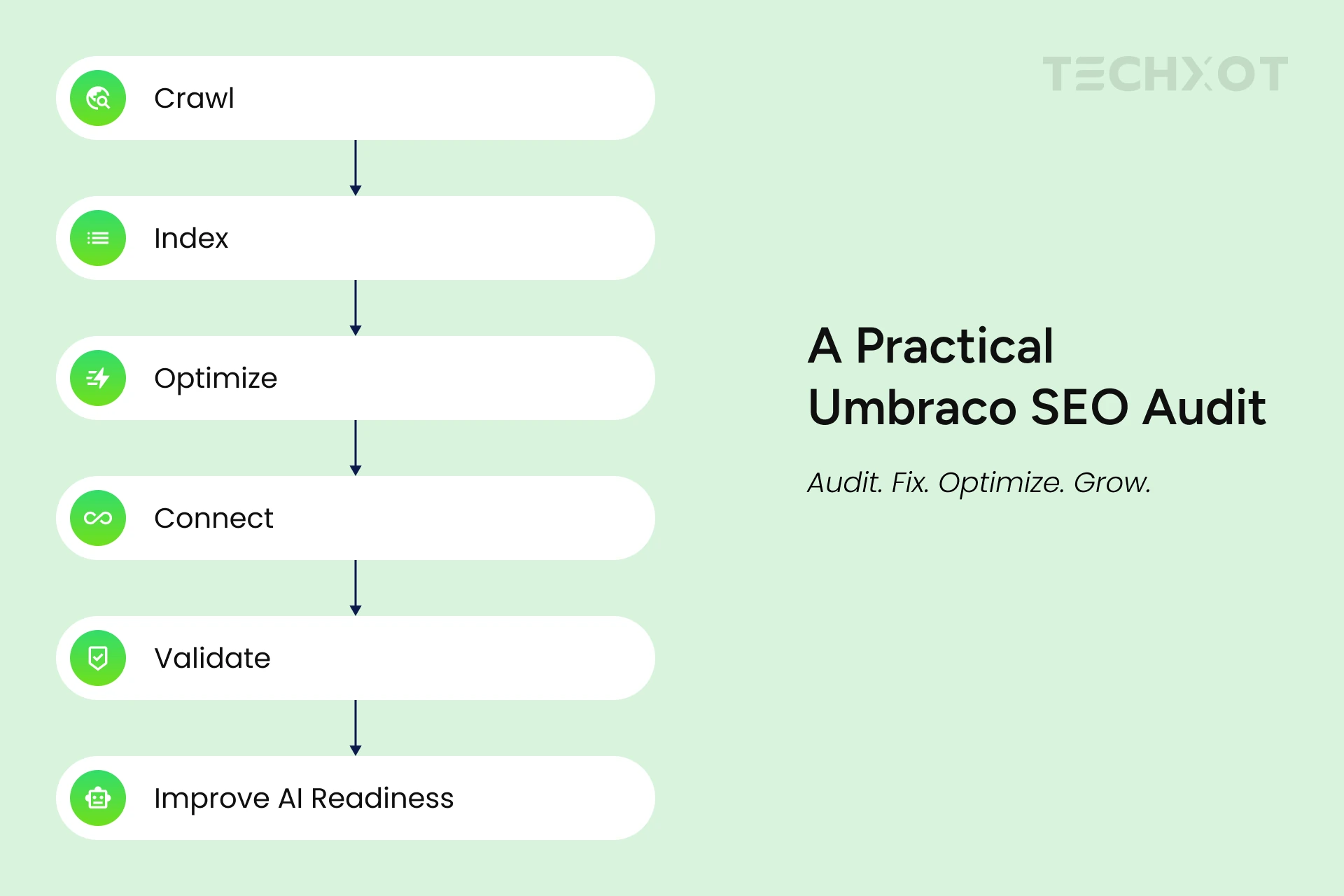
12. How Do You Audit An Umbraco Website For SEO?
Every enterprise website needs timely assessment and auditing. It helps developers and SEO experts to optimize their SEO efforts. Our Umbraco SEO audits priorities identifying issues that affect organic visibility, performance and business outcomes for our clients.
13. Umbraco SEO Best Practices
Element | Weak implementation | Better Umbraco implementation |
|---|---|---|
URL | /page?id=123 | /services/umbraco-development/ |
Title | Umbraco Services | Umbraco Development Services | Enterprise Development |
H1 | Services | Umbraco Development Services |
Content | Generic platform description | Search-intent-driven service content |
Internal link | “Learn more” | “Explore Umbraco migration services” |
Image | image123.jpg | descriptive filename + relevant alt text |
Schema | Same schema everywhere | Schema selected according to page type |
FAQ | Long paragraph | Question heading + concise answer |
AEO | Generic explanation | Direct answer followed by supporting evidence |
GEO | “We provide Umbraco solutions” | Explicit organization → service → technology relationships |
14. Final Takeaways
Technical SEO ensures proper implementation of crawling, indexing, URLs, redirects, sitemaps
Umbraco SEO is not just meta data and meta description, it is search-intent-driven strategy
Create content that is easily discoverable by AI search systems
Use schema according to each page types
Website performance drives overall search experience
In Umbraco projects, SEO is not an afterthought, rather a full stack strategy to be implemented from beginning to the end of the project
15. Conclusion
The modern Umbraco SEO is no longer limited to metadata and keywords.
At Techxot, we follow a strategy that combines technical SEO, search intent, website performance, structured data, AEO, GEO and EEAT into a consistent content architecture.
Our strategy always has objectives like; website should be easy for users to use, easy for search engines to understand, useful for AI systems to retrieve required information.
If you are an enterprise experiencing declining organic visibility, a complete Umbraco SEO Audit can help identify technical barriers, gaps and issues that can help strengthen search visibility and choosing the right Umbraco implementation partner always encourages implementing strategies that are optimized for best performance.