
1. Introduction
Umbraco AI readiness means preparing Umbraco platform, content, architectures, APIs, security and governance. This ensures that AI applications extract all business information reliably and securely. AI readiness doesn’t mean connecting AI models directly to your enterprise CMS. Instead, it is implementing structured content foundations, having controlled delivery layers, governed by AI integrations, and operational frameworks.
After 10+ years of in Umbraco implementation, Techxot believes the best starting point for a successful enterprise business implementation is a strategically strong foundation that demonstrates what AI can access, understand, retrieve, generate and publish.
2. What Does AI Readiness in Umbraco Actually Mean?
Umbraco AI readiness means preparing your Umbraco CMS, APIs, content models, integrations and governance, so AI systems have seamless and secure access to your enterprise business content.
Evaluate AI readiness in your Umbraco solutions:
Content readiness
Evaluate content readiness by content structures, accuracy, reusability, and easy AI interpretation.
API readiness
The Umbraco Content Delivery API should securely expose published content to AI systems.
Architectural readiness
The integration layer must seamlessly connect Umbraco with AI models, search, retrieval, and various external services with your CMS platform.
Governance readiness
Governance demand defined control over permissions, human approvals, ownership, auditability, and sensitive information.
Operational readiness
The Implemented Umbraco solutions must support performance, monitoring, testing, scalability, and measurable business outcomes.
This strategy matters because AI systems undervalue poor content sources.
3. Is your Umbraco Content Architecture Ready for AI?
All AI systems demand content to be easy to retrieve, interpret, classify, and relevant.
For an instance, if an enterprise business website has product page with structure as follows:
Product name
Product description
Product specification
Product features
Related FAQs
Similar products
Documentation
Categories
AI applications easily interpret the above page structure when information is given in rich-text fields.
Example: Create an AI friendly Content presentation
public class ProductAiModel

{

public string Name { get; set; }

public string Summary { get; set; }

public string Category { get; set; }

public List<string> Features { get; set; }

public List<string> FAQs { get; set; }

public string Url { get; set; }

}
This doesn’t mean creating a new CMS, it is rather having a controlled representation of existing Umbraco content that is passed to AI systems.
4. What Should You Audit Before Preparing Umbraco for AI?
Review the following before preparing Umbraco for AI:
Property types
Document types
Content relationship
Metadata
Content lifecycle
Taxonomies
Outdated content
Duplicated content
Editorial ownership
Multilingual variety
The objective is to demonstrate the exact meaning of the information to the AI systems and not keep them guessing.
5. How Is AI Readiness Supported by Umbraco Content Delivery APIs?
the Umbraco Content Delivery API establishes connection between published Umbraco content and external apps.
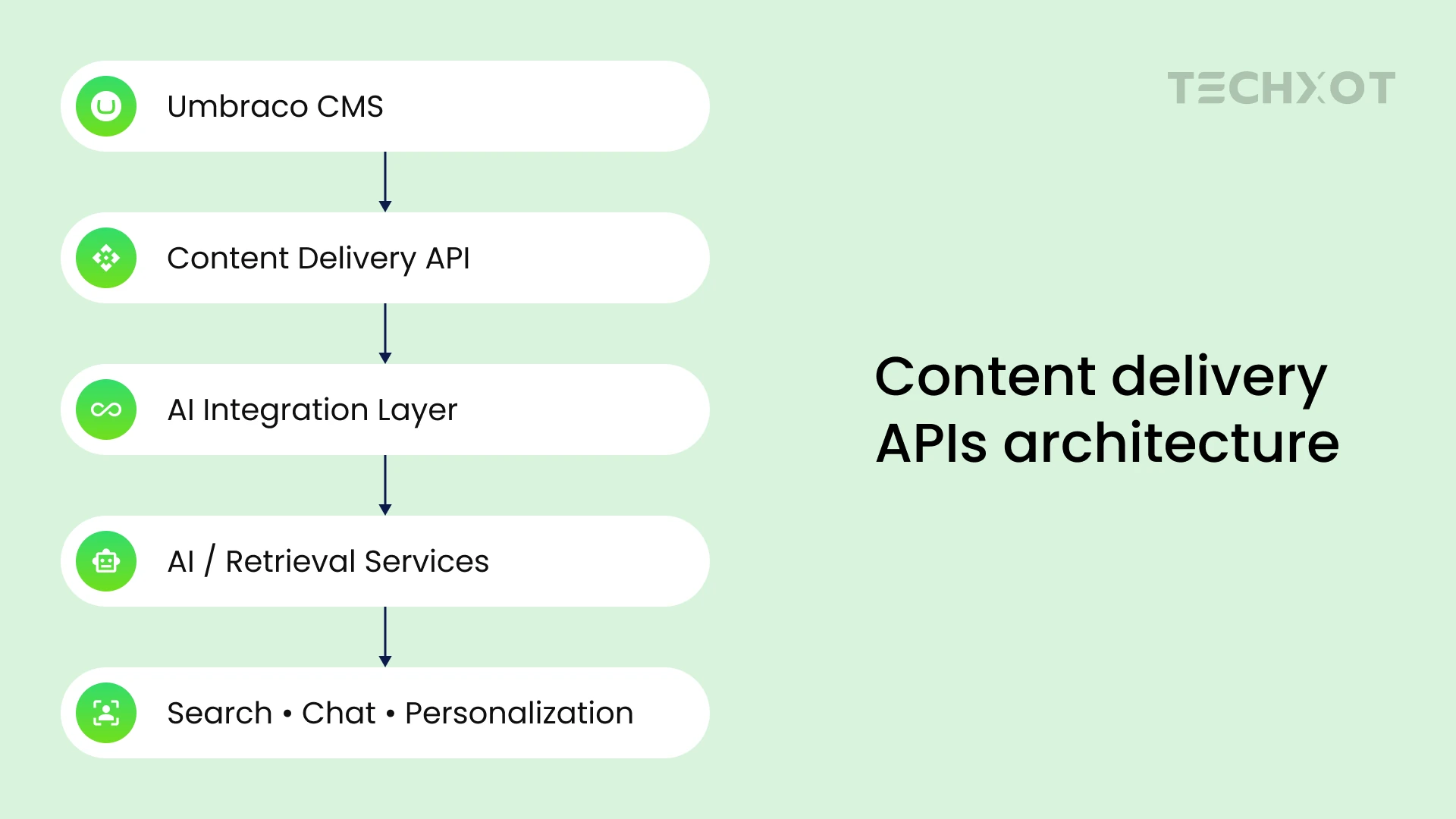
An enterprise Umbraco API integration must define:
What authentication is required
What data applications can retrieve
Which content is exposed
How content is transformed
How API usage is monitored
For example:
AI systems retrieve product information approved through content delivery APIs. This eliminates the need to access internal editorial fields.
public class ContentService

{

private readonly HttpClient _httpClient;

public ContentService(HttpClient httpClient)

{

_httpClient = httpClient;

}

public async Task<string> GetContentAsync(string url)

{

using var response = await _httpClient.GetAsync(url);

response.EnsureSuccessStatusCode();

return await response.Content.ReadAsStringAsync();

}

}
For production implementation, it is important to address authentication, authorization, caching, error handling, and API configuration.
6. Why is AI content governance essential for enterprise Umbraco?
AI governance demonstrates how AI-generated content is created, reviewed, approved, published, and monitored.
If governance is ignored, AI workflows can carry factual errors, outdated information, or unauthorized content changes.
A governance model should define:
What content AI can access
What content AI can create
How API outputs are reviewed
Which content requires human approval
How content is protected
For example: How to approve AI content workflows
public enum AiContentStatus

{

Draft,

AiGenerated,

HumanReview,

Approved,

Rejected

}

public class AiContentItem

{

public Guid ContentId { get; set; }

public AiContentStatus Status { get; set; }

public string SourceContentId { get; set; }

public DateTime CreatedAt { get; set; }

public string ReviewedBy { get; set; }

}
It is important to understand that AI content generation is not equivalent to publishing. Human interventions are crucial in financial, healthcare, legal, and high-consequence content.
7. How An AI Integration Architecture for Umbraco Be?
AI integration architectures separate every Umbraco implementation model layer. This encourages AI in Umbraco to easily evolve.
The following Umbraco architecture explains how AI fits in:
Stage 1: Umbraco CMS allows for content creation, editing, workflow, and publishing.
Stage 2: Content Delivery API exposes approved published content to external applications.
Stage 3: AI integration layer follows authentication, business rules, retrieval logic and orchestration.
Stage 4: AI service models extract relevant information to invoke certain AI capabilities.
Stage 5: Experience layer promotes search, chat, personalization, automation and recommendations.
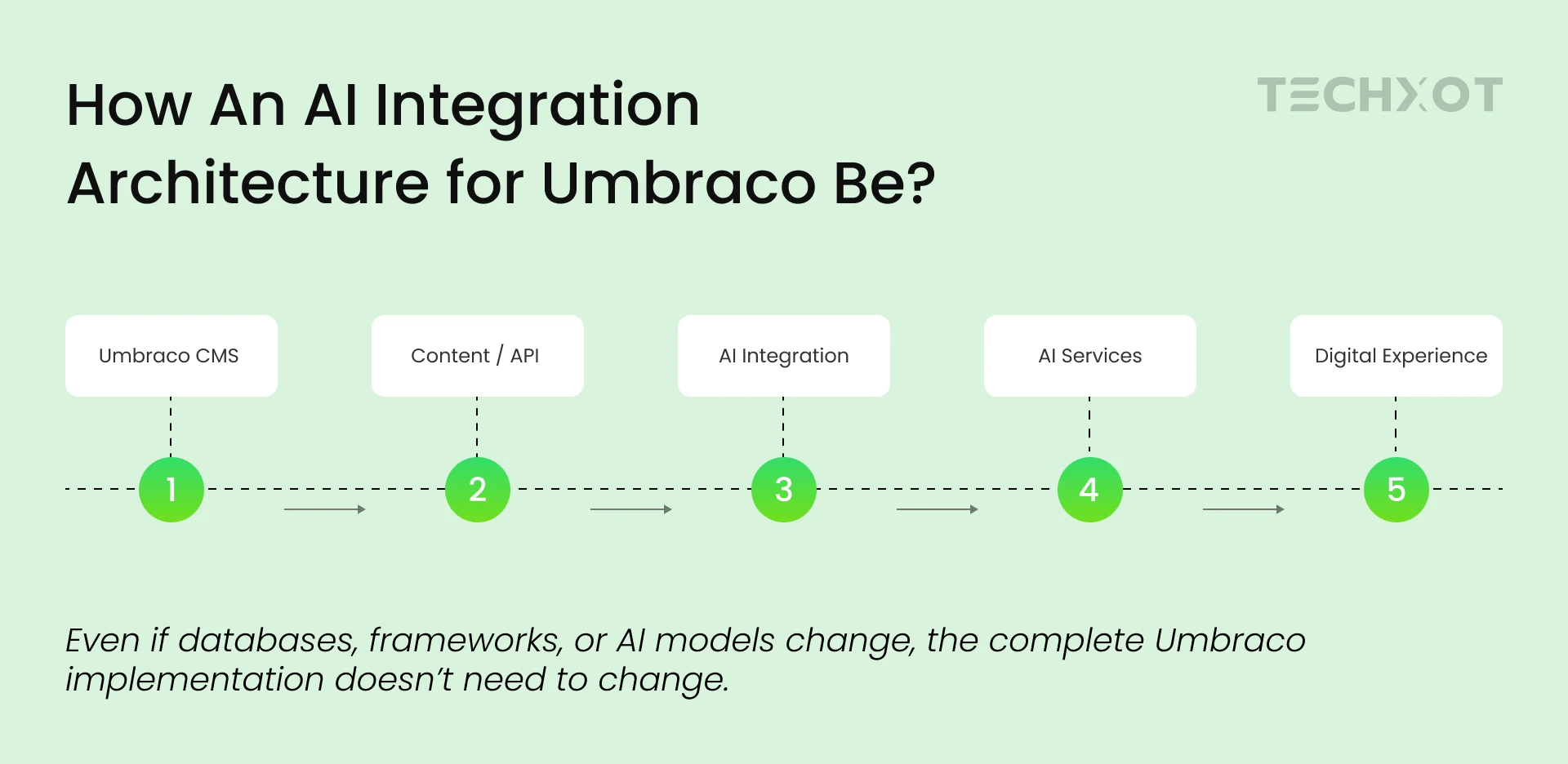
Even if databases, frameworks, or AI models change, the complete Umbraco implementation doesn’t need to change.
8. How Should You Prepare Umbraco for RAG And AI Search?
The retrieval-augmented generation (RAG) ensures the AI applications to extract relevant data from approved content, before delivering the response. AI readiness is not about choosing AI vendor or model, the objective are to make content structured, authorized, updated and extractable.
Umbraco content must be prepared for retrieval and not just to be copied.
A structured content record should contain the following:
 public class ContentChunk

{

public string ContentId { get; set; }

public string Title { get; set; }

public string Content { get; set; }

public string ContentType { get; set; }

public string Url { get; set; }

public string[] Categories { get; set; }

}
The applications decide how content is chucked, indexed, embedded, and retrieved for AI systems. It’s important to understand that preparing doesn’t mean choosing AI vendor. It means ensuring content is authorized, structured, and current.
9. What Is Required for Enterprise Umbraco AI Readiness?
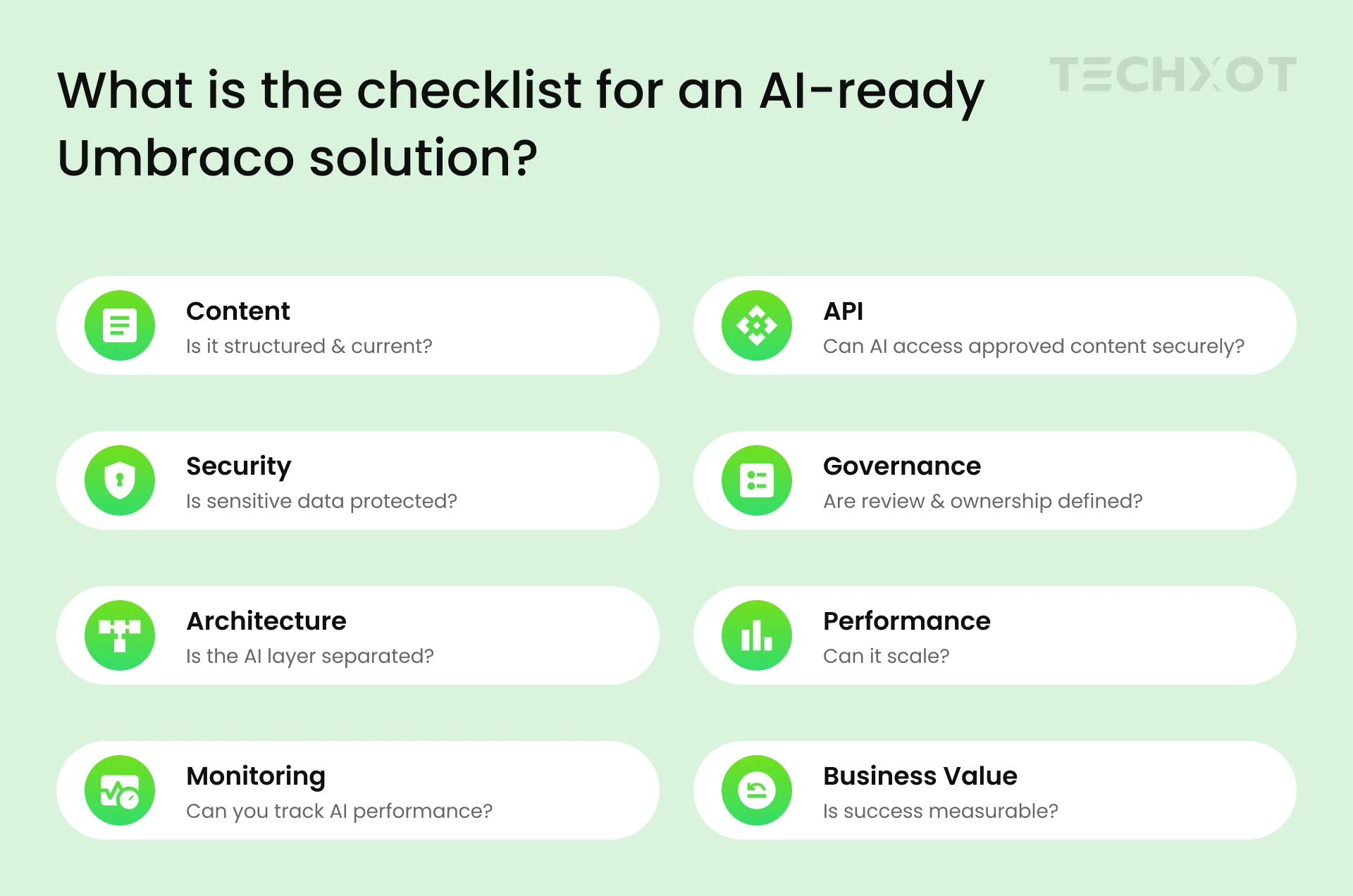
Evaluate your enterprise Umbraco API readiness before Implementations.
Readiness area | Questions to ask |
|---|---|
Content | Is the information accurate and structured? |
API | Can approved content be accessed safely? |
Security | What information must never enter an AI workflow? |
Governance | Who approves AI-generated content? |
Architecture | Can AI services evolve independently? |
Performance | Can API and AI traffic scale? |
Monitoring | Can failures and AI outputs be tracked? |
Business value | What measurable outcome will AI improve? |
10. How Can Enterprises Build a Practical Umbraco AI Strategy?
Always focus on the bigger business problem rather the technology.
Business problem: Target customers find it difficult to trace technical product information.
The solution to this is implementing structured product content, having controlled access to published content, composed retrieval-based AI search, proven governance, and performance monitoring.
Techxot as an official Umbraco partner, believes AI readiness should be CMS architecture exercise and not an external AI integration to be implemented separately.
11. What should you verify before an Umbraco AI implementation?
Before an enterprise starts Umbraco AI development, run a technical readiness assessment.
Recognize high value content types with structured and reusable information.
Document what Content delivery API exposes and determine if content is correct for AI use cases.
Restrict sensitive, confidential and internal information from AI workflows.
Have human interventions in terms of approvals, ownership, and auditability.
Define Umbraco, search, integration, analytics and proposed AI service.
Testify performance in terms of API response times, caching, and infrastructure capacity.
Map measurable business outcomes before AI implementation starts.
Following this assessment depicts a clear picture of AI-powered content management system. It’s demonstrates how not to assume co tent readiness, APIs safety, and AI output accuracy.
12. What is the checklist for an AI-ready Umbraco solution?
13. Final Takeaway:
Structure Umbraco content for AI.
Make APIs AI-accessible and secure.
Establish strong AI content governance.
Build a flexible AI integration architecture.
Protect sensitive enterprise data.
Align AI with measurable business goals.
14. Conclusion
An AI-ready Umbraco implementation is not created by simply connecting an AI model to Umbraco. It is about building foundation that supports AI integrations. Building structured content, controlled APIs, scalable architecture, retrieval logics, governance and operations is considered.
Start with an AI readiness assessment as the first practical step to identifies gaps across implemented Umbraco solutions.
Techxot after 30+ implementation and migration projects believes, we cannot make the Umbraco platform AI ready , rather make Umbraco solutions ready for AI integrations.
Get in touch with our Umbraco experts today!