
Introduction
The digital landscape is rapidly evolving, And the way we build and deliver content is changing. In the past, many systems were built on a monolithic architecture, tightly coupling the Frontend, Backend, and Database where they all are part of a single system. Today, businesses are shifting towards headless architectures that decouple these layers, allowing developers to use modern frameworks like ReactJS, Next JS, and Vue JS which helps to develop and deliver the application faster. This blog will provide a detailed comparison between Monolithic and Headless CMS.
Monolithic CMS
When we work on any content management systems (CMS), the two terms “monolithic” and “headless” always come into the picture.
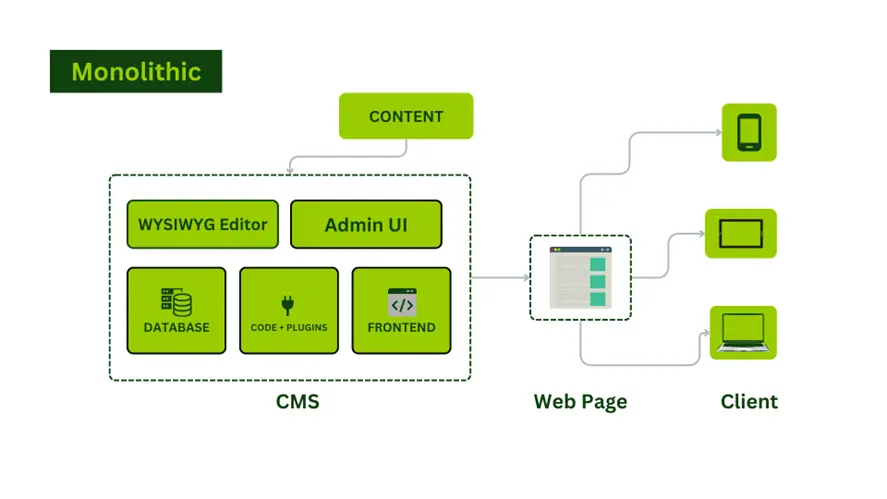
Monolithic CMS, clubs or integrates the Frontend, Backend, and Database into a single unit, or they all are placed-in-one solution.
In this approach Backend is responsible for content management, and the Frontend is the visible part of a website or application experienced by users.
Here the user interface is optimized and easy to use by allowing content creators to manage and publish content without developers.
Challenges of Monolithic CMS
Reduced flexibility in customization
Ready-made templates: Restrict flexibility in unique digital creations.
Prebuilt themes: Changing more than the available theme can take a lot of time and make development slow
Fixed structure: This can be a problem when business or technology changes fast.
Tied to a single system
Single-source weakness: The failure of one component can cause issues across the entire system.
Lack of adaptability: Changes to the user interface often require updates throughout the system, making it hard to deliver the updates.
Simplified workflows: A single codebase often meant quicker initial deployments.
Optimization and adaptability
Performance: It may not handle large amounts of content well and can slow down website performance.
Flexibility: It is less flexible for improving technical SEO compared to headless systems.
How does Headless CMS overcome the challenges of Monolithic CMS?
Flexibility & Technology Choice
Monolithic CMS: We are locked into the built-in frontend technology (e.g., Sitecore MVC, WordPress themes). Customization is difficult.
Headless CMS: We can use any modern frontend framework (React, Next.js, Vue, Angular) for a better user experience.
Performance & Speed
Monolithic CMS: The system loads everything together, making it slower, especially under high traffic.
Headless CMS: Delivers content through APIs, improving speed and allowing for optimized frontend performance.
Scalability
Monolithic CMS: Scaling requires upgrading the whole system, which is complex and costly.
Headless CMS: Can scale independently by optimizing different parts (backend, frontend, database) separately.
Multi-Platform Content Delivery
Monolithic CMS: Primarily designed for websites, making it hard to deliver content to mobile apps, smart devices, or other digital platforms.
Headless CMS: Content is stored centrally and delivered via APIs to any platform (web, mobile, IoT, etc.).
Future-proofing
Monolithic CMS: Upgrading or migrating to new technologies is difficult and expensive.
Headless CMS: Supports modern development trends, making it easier to integrate future technologies.
What is Headless CMS?
Headless architecture decouples the Frontend (head) from the Backend.
In a headless setup, the content is managed in the backend and delivered via APIs to any frontend application.
Headless CMS uses an API-first approach, making it easy to connect with different devices and channels. This flexible design allows for faster updates, better scalability, and more innovation.
Headless CMS uses an API-first approach, making it easy to connect with different devices and channels. This flexible design allows for faster updates, better scalability, and more innovation.
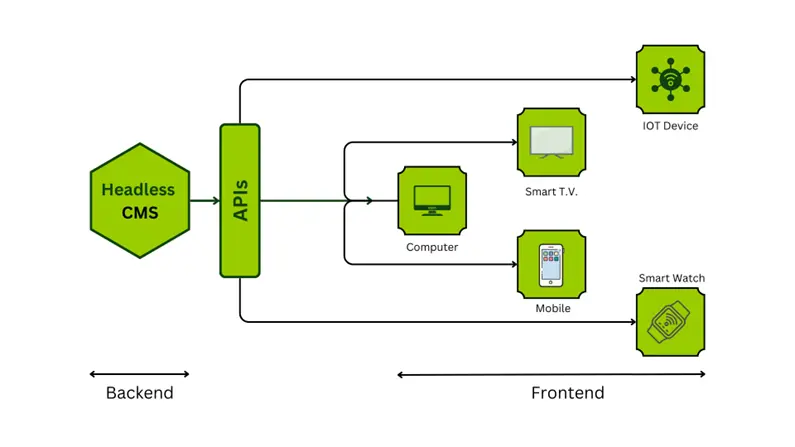
By decoupling the Frontend from the Backend, headless architecture empowers organizations to quickly adapt to market trends and deliver exceptional omnichannel experiences.
Another advantage of a headless CMS is its ability to speed up content deployment. The separation of frontend and backend allows teams to make updates, improve user experiences, or making strategies without waiting for backend alignment. In this sense, a headless CMS is not just a better tool but can also facilitate an agile and responsive approach in a fast-paced market.
A headless CMS centralizes content within a cloud-based repository, simplifying content creation and distribution for content creators and marketing teams. It serves as the single source of truth, fostering content reusability and aiding marketers in streamlining their campaigns to meet business objectives.
A headless CMS’s security benefits from its composable architecture, as individual components can be isolated and protected. This means that should a security concern arise, it need not compromise the entire system but can be contained and resolved with little disruption.
Some popular Headless CMS are: Sitecore, Sitefinity, Optimizely, Sanity, Contentful, etc.
Advantages
Lightweight design for better responsiveness:
Headless is decoupled and it allows the data that is coming from the APIs and display the content in the Head (Frontend), due to which the head becomes lighter. We can attach various frontend technologies to the Headless, so we can create a feature-loaded application that is faster even with complex content or design requirements and results in better performance.
More dynamic and adjustable structure:
The way Headless decouples the presentation layer from the backend allows businesses to have various options to choose the frontend seamlessly. We can reshape the content to adapt to the user experiences; it also supports the rapid change and time to market. The separation of content from presentation also future proofs the system.
Security is enhanced because of decoupled architecture:
The content management system (CMS) is not directly exposed to the public internet, reducing the risk of attacks such as SQL injection and cross-site scripting (XSS). A headless CMS allows for static content delivery via CDNs, which reduces direct interactions with the CMS, making it more secure.
Capable of delivering multi-channel content:
Data is exposed to the frontend via APIs it enabling to adapt different endpoints dynamically. This approach helps to streamline content creators and marketing teams, to spend less time on the content formatting and more time on making strategies to market the product.
Streamlined coding and development process:
Modern frontend frameworks such as Next.js offer greater freedom. So, the design team can focus on creating the best user experiences without constantly checking the backend.
Why to choose a Headless CMS?
Best-in-Class Technology – Leverage top-tier tools for each element of your project.
Omnichannel Content Delivery – Seamlessly distribute content across multiple platforms and devices.
SEO Excellence –Utilize advanced tools to enhance search engine rankings.
Future-Proof Architecture – Ensure long-term scalability and adaptability with a modern, flexible system.
Multi-Platform Flexibility – Deliver content effortlessly across websites, mobile apps, IoT devices, and more.
Enhanced Content Management – Benefit from improved collaboration, faster publishing, and structured workflows.
Seamless Integrations – Connect effortlessly with your existing tech stack and third-party applications.
Superior User Experience – Provide optimized, personalized, and dynamic experiences for your audience.
High-Performance Delivery – Achieve faster load times and improved conversion rates.
Consistent Brand Presence – Maintain a cohesive brand experience across all digital touchpoints.
A headless CMS is the best choice over a monolithic CMS because it offers greater flexibility, scalability, and performance. It allows you to deliver content across multiple platforms (web, mobile, IoT) efficiently, ensures faster development, and provides better security and future-proofing. With a decoupled architecture, teams can work independently, leading to quicker updates and seamless integrations, making it the ideal solution for modern digital experiences.